


Multifocal Contacts vs Reading Glasses: Which Is Right for You?

Somewhere around age 40, the menu at your favorite restaurant starts requiring better lighting. Text messages need to be held at arm's length. The vision that carried you through decades of reading (often in low lights), screen time, and close-up work quietly begins to struggle with anything nearby.
This is presbyopia, and it happens to nearly everyone. The question is not whether to correct it; it is which correction fits your life. For most people, the first answer is a pair of reading glasses. But as presbyopia progresses, readers become a constant companion you are always setting down and searching for. Multifocal contact lenses offer a different path: prescription correction for near, intermediate, and far distances built into a single lens that moves with your eye.
Choosing between them depends on your lifestyle, your eye health, and how much visual friction you are willing to accept.
What Presbyopia Does to Your Near Vision After 40

The lens inside your eye flexes to shift focus between near and far objects. That flexibility depends on a ring of tiny muscles and the elasticity of the lens itself. As we age, the lens stiffens. The muscles still work, but the lens no longer responds the way it once did. This is presbyopia, and unlike nearsightedness or farsightedness, it is not a refractive error corrected by changing the lens shape. It is a physical change in how well the eye accommodates, and it progresses gradually until around age 65.
The American Academy of Ophthalmology (AAO) confirms that presbyopia affects virtually everyone, regardless of whether they needed vision correction earlier in life.
Reading glasses and multifocal contact lenses both compensate for this loss of accommodation. Understanding how each works makes the choice between them easier.
How Multifocal Contact Lenses Work
A multifocal contact lens contains multiple prescription zones in a single lens, allowing the eye to see clearly at different distances simultaneously. The brain learns to select the appropriate zone based on what the wearer is looking at, a process called neuroadaptation.
Most modern soft multifocal lenses use one of two designs:
Simultaneous Vision Design
All prescription zones are present across the lens at the same time. As your pupil size shifts with ambient light and the distance of your target, your visual system draws from the most relevant zone. This is the most common design in today's multifocal contact lenses.
Alternating (Translating) Vision Design
The lens physically shifts on the eye as you look up or down, positioning the correct zone over the pupil. Found mainly in rigid gas permeable lenses, this design functions more like a bifocal eyeglass lens.
Within simultaneous designs, lenses are either aspheric (a gradual power gradient from center to edge, similar to progressive glasses) or concentric (alternating rings of near and distance correction). The optometrist selects the design based on your prescription, pupil size, and how your eye performs during fitting. The fitting process for multifocal lenses is more involved than for standard single-vision contacts, and it often requires a follow-up visit to fine-tune the prescription balance.
How Reading Glasses Correct Presbyopia
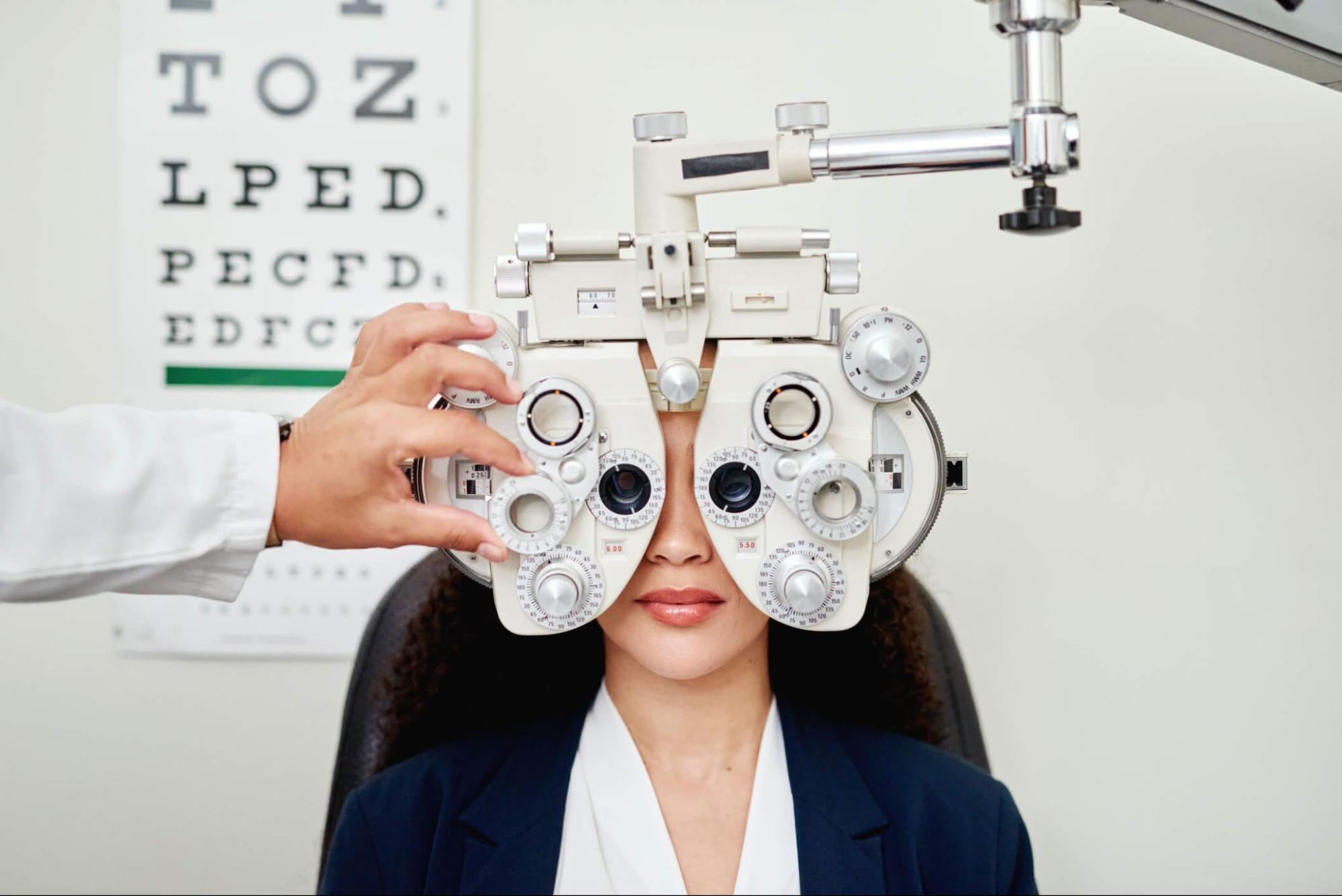
Reading glasses add magnification to compensate for lost near-vision focusing ability. Over-the-counter (OTC) readers (the same ones in the check-out line at the bookstore) do this with a uniform power across both lenses. Prescription reading glasses are customized to your specific correction, including any astigmatism.
Progressive addition lenses (PALs), often called progressives or no-line bifocals, build three vision zones into a single lens: distance at the top, intermediate in the middle, and near at the bottom. They eliminate the need to switch between two separate pairs of glasses, but they require a head-positioning adjustment to find the right zone. For some wearers, the peripheral distortion in progressive lenses takes several weeks to accept.
Reading glasses carry no infection risk and require no adaptation period for basic pairs. The tradeoff is straightforward: they only help while you are wearing them, and they do nothing for distance vision while on.
Multifocal Contacts vs Reading Glasses: Side-by-Side

Presbyopia correction is not without compromise, and multifocal contact lenses are no exception. The four tradeoffs below are not reasons to rule them out, as millions of wearers accept them willingly for the freedom multifocals provide. But wearers who understand what to expect before their first fitting are less likely to abandon the lenses during the adjustment period and more likely to consider the experience a success.
Multifocal Contacts vs. Reading Glasses
Both contact lenses and reading glasses can correct presbyopia. Where they differ is in how they fit into a full day of living. Multifocal contact lenses correct vision at all distances from the moment you put them in. Reading glasses correct only near vision, and only when worn. That single distinction drives most of the tradeoffs across convenience, visual performance, and lifestyle compatibility.
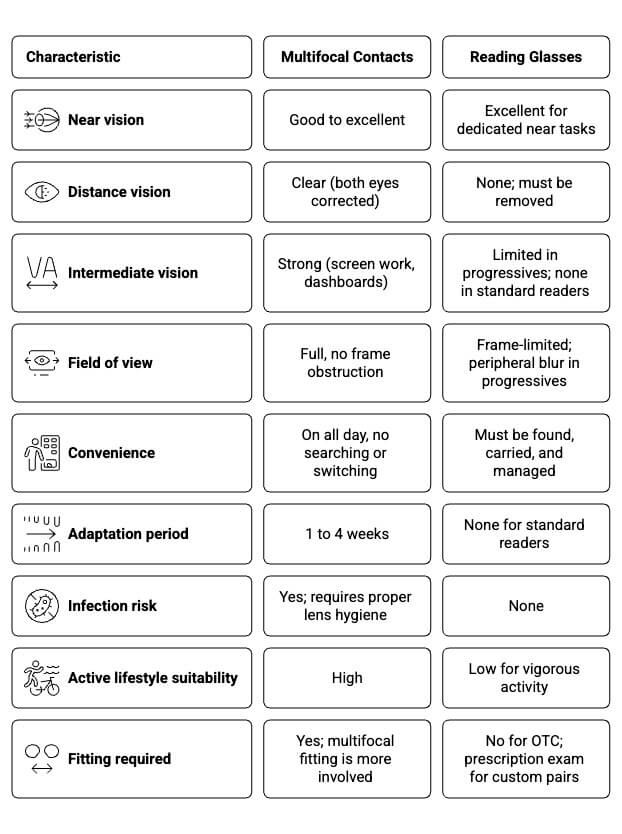
The right choice often comes down to: How frequently do you need near sight vision correction throughout the day? And how much does wearing glasses interfere with how you move through life?
Why Multifocal Contact Lenses Work Well for Reading
Multifocal contact lenses for reading solve the problem that trips (and annoys) most readers users up: the constant switching. You put them in once in the morning, and your vision works across all distances for the rest of the day, with no frames to remove, lose, or manage.
For anyone who spends long hours at a computer, this advantage is specific and measurable. Progressive glasses require tilting the head downward to find the intermediate zone, and holding that position across a full workday creates neck and shoulder strain. With multifocal contacts, you look straight at the screen and see it clearly, at a natural head and neck angle.
Athletes, parents, travelers, and anyone whose day involves frequent movement benefit from the same freedom. There is no fogging in cold weather, no slipping during exercise, and no frame edge cutting off peripheral vision during sports.
A 2024 study published in Scientific Reports evaluated presbyopic patients wearing refractive multifocal contact lenses and found patient satisfaction scores of 96.2 out of 100 for distance vision, 91.9 for intermediate, and 85.0 for near, strong performance across all three viewing distances.
A different 2024 analysis published in Contact Lens and Anterior Eye reviewed over 52,000 soft lens fits across 20 countries and found that multifocal and monovision prescribing for presbyopia more than doubled between 2000 and 2023, rising from 26.4% to 61.1%. Optometrists are fitting more multifocal lenses than ever before, and patient outcomes are driving that shift.
When Reading Glasses Outperform Multifocal Contact Lenses

Reading glasses make the most sense for people who need near vision correction only occasionally. If close-up help is limited to evening reading or periodic detail work, a pair of OTC readers is a practical and low-maintenance solution.
For people with conditions that limit contact lens wear, reading glasses are not a fallback; they are the appropriate choice. Moderate to severe dry eyes, a history of corneal infection, or an irregular corneal surface may make extended contact lens wear uncomfortable or inadvisable. No contact lens, multifocal or otherwise, belongs to an eye that cannot tolerate it well.
Reading glasses also deliver the sharpest possible near vision without optical compromise. Because multifocal contacts process multiple zones simultaneously, there is some reduction in contrast sensitivity, particularly in low light.
For tasks requiring maximum near-vision clarity, such as fine print, detailed craft work, or close inspection, prescription reading glasses may outperform multifocal lenses.
What Are the Disadvantages of Multifocal Contact Lenses?
Multifocal contact lenses involve real tradeoffs worth understanding before committing.
Vision Compromise: Because the lens delivers multiple prescription zones simultaneously, neither near nor distance vision is as sharp as a single-vision lens optimized for one distance.
Most practitioners describe success using the "80% rule": if you are satisfied with your vision 80% of the time without reaching for readers, the fit is working. If you need precise near clarity for detailed tasks, multifocals may leave you wanting a supplemental reader.
Low-light Performance: Halos and reduced contrast in dim conditions are the most common early complaints. The effect relates to how the pupil dilates in low light and interacts with the lens's power zones. For most wearers, this improves as neuroadaptation progresses. Night driving may feel different during the adjustment period.
Fitting Complexity: Getting multifocal contacts right often requires multiple office visits for eye exams. The fitting process considers pupil size, dominant eye, and the balance between near and distance prescription power. More follow-up than standard single-vision lenses is typical.
Hygiene Demands: Any contact lens worn daily requires proper cleaning, storage, and replacement discipline. Skipping steps increases the risk of eye infection. Daily disposable multifocal lenses reduce this burden by eliminating the need for overnight storage and solution.
Understanding these tradeoffs upfront sets realistic expectations and improves the chance of a successful fit.
Who Is Not a Good Candidate for Multifocal Lenses?
Multifocal contact lenses do not suit everyone. Several conditions meaningfully reduce the chance of a successful fit.
Moderate to Severe Dry Eye: Contact lenses sit directly on the tear film. Anyone whose tear production is compromised may find extended daily wear uncomfortable or impossible. Dry eye is the most common reason experienced wearers stop using contacts altogether.
High Astigmatism: Multifocal lenses perform best on relatively spherical corneas. Significant astigmatism interferes with lens stability and zone alignment. Toric multifocal lenses address mild astigmatism, but higher corrections remain difficult to fit well.
Advanced Presbyopia: Patients in the later stages of presbyopia, generally those over 65 with a high add power requirement, often need more near correction than soft multifocal lenses can fully deliver. Reading glasses may provide sharper near vision at this stage.
Occupations Requiring Precise Vision at a Fixed Distance: Surgeons, pilots, and professional drivers whose work demands absolute clarity at one specific distance may find the visual compromise of multifocal lenses unacceptable in a professional setting.
First-time Wearers With Limited Motivation: The adaptation period requires consistent daily wear and patience. Someone ambivalent about contact lenses is unlikely to wear them consistently enough for neuroadaptation to take hold.
Confirming candidacy with an eye doctor before committing to a fitting is the right first step.
How Long Can You Wear Multifocal Contacts Each Day?
Daily wear duration for multifocal contact lenses follows the same guidelines as soft contact lens. Most eye care professionals recommend wearing contacts for no more than 10 to 16 hours per day, depending on the specific lens brand and your individual tear film health.
Daily disposable multifocal lenses are discarded at the end of each wear day, which eliminates protein buildup and reduces infection risk. Monthly and biweekly replacement lenses require daily cleaning with contact lens solution and kept in a clean overnight storage case.
Sleeping in contact lenses, including those with FDA approval for extended wear, significantly increases the risk of corneal hypoxia and microbial keratitis. Most optometrists advise against overnight wear unless there is a specific clinical reason and ongoing medical supervision.
If your eyes feel dry, irritated, or your vision blurs late in the day, those are signals to remove the lenses and allow your eyes to rest. Consistent daily wear within recommended hours gives your eyes the best chance of tolerating multifocal contacts long-term.
Progressive Contacts vs Glasses: Understanding the Difference

People who already wear progressive glasses often ask whether multifocal contact lenses can replicate the same all-distance correction. They can, but the visual experience differs in meaningful ways.
Progressive glasses correct all three distances through distinct zones navigated by tilting and moving the head. The top of the lens handles distance, the middle corridor handles intermediate, and the bottom handles near. Peripheral vision through the lens edges is often distorted, and adaptation to progressives takes several weeks for many wearers.
Multifocal contact lenses provide a comparable distance range through simultaneous rather than zonal vision. You do not move your head to access the near or distance zone; the visual system selects automatically. Side vision remains clear because there are no lens edges restricting the peripheral field.
The tradeoff is that progressives can deliver a sharper vision within each dedicated zone, while multifocal contacts blend zones continuously. People with higher additional power requirements often find progressives sharper for sustained close work. People with active lifestyles or screen-heavy workdays often prefer multifocal contacts for the freedom of movement and the natural head position they allow.
For many wearers over 40, the choice between progressive contacts vs glasses comes down to where they spend most of their day, at a desk or on the move.
Using Multifocal Contacts and Reading Glasses Together
Using multifocal contacts alongside reading glasses is not a compromise. For many people, it is the most practical long-term approach.
Distance contacts paired with a low-power reader for fine print is a common and effective setup. The contact prescription handles distance and screen use, while reading glasses manage sustained close work. Daily disposable contacts make this especially flexible: wear them on days requiring maximum visual freedom, skip them when the day is slower.
The right combination depends on your prescription, your daily demands, and how your eyes tolerate contact lens wear.
Choosing Between Multifocal Contacts and Reading Glasses

Reading glasses suit people who need near vision correction occasionally and prefer a simple, no-maintenance solution. Multifocal contact lenses suit people who want all-day, all-distance clarity without the management that glasses require. Neither is a permanent decision.
Many people in their 40s and early 50s start with readers, then move to multifocal contacts as presbyopia deepens and lifestyle demands change. That progression is common and reasonable. The best option is the one that fits your current vision needs and daily routine without creating new issues.
If you already have a multifocal contact lens prescription and are ready to reorder, explore PerfectLensWorld's full selection of multifocal contact lenses. If you are still deciding, schedule a contact lens exam with your eye doctor. Multifocal fitting requires more precision than standard lenses, and the right fit is what separates a frustrating experience from a successful one for the long haul.
Frequently Asked Questions About Multifocal Contact Lenses
How Long Does It Take To Adjust to Multifocal Contacts?
Most wearers adapt within one to four weeks of consistent daily use. During that period, some fluctuation in near or distance sharpness is normal. Wearing the lenses every day, rather than intermittently, is what allows neuroadaptation to progress. If vision remains unstable after four weeks, a follow-up fitting visit to adjust the prescription balance is the right move.
Do Multifocal Contacts Affect Night Vision?
Some wearers notice halos or reduced contrast in low-light conditions, particularly during the first weeks of wear. This happens because the pupil dilates in dim light and interacts with multiple power zones in the lens. The effect diminishes for most wearers as adaptation progresses. Persistent night vision issues beyond the adjustment period are worth raising with your optometrist, as a prescription adjustment may help.
Can I Wear Multifocal Contacts if I Have Astigmatism?
Mild to moderate astigmatism does not automatically disqualify someone from wearing multifocal contacts. Toric multifocal lenses correct both presbyopia and astigmatism in a single lens. Higher degrees of astigmatism are more difficult to fit and may reduce the clarity multifocal lenses can deliver.
Your optometrist's fitting evaluation will confirm whether your level of astigmatism is compatible with a multifocal design.
Can I Buy Multifocal Contact Lenses Online?
Yes. With a valid contact lens prescription that specifies a multifocal or presbyopia correction, you can order the same lens brand and parameters online.
PerfectLensWorld carries multifocal contact lenses from major brands with straightforward reordering. Prescriptions will include the specific lens name, power, and add strength the based on the optometrist’s recommendations and has fitting.

