


A Beginner-Friendly Glossary of Contact Lens Terms

You've just left your eye doctor's office with a piece of paper covered in abbreviations, decimal numbers, and what might as well be another language. Or maybe you've been wearing contacts for years and never stopped to ask what "BC 8.6" actually means.
Either way, your contact lens prescription contains everything a manufacturer needs to make a lens that fits your eye precisely. Once you know what each field means, ordering contacts, whether for the first time or switching to a better brand, becomes straightforward.
Contact Lens Glossary
- What Is a Contact Lens Prescription?
- Are Contact Lens Prescriptions the Same as Glasses?
- How to Read Your Contact Lens Prescription
- Contact Lens Prescription Reference Chart
- What Your Prescription Does Not Include
- How Long Is a Contact Lens Prescription Good For?
- Key Terms Beyond the Prescription
- Ready to Order?
What Is a Contact Lens Prescription?
A contact lens prescription is a written specification from a licensed eye doctor that tells lens manufacturers exactly what your eye needs. It goes beyond vision correction; it also accounts for the physical shape of your eye so the lens fits properly, sits comfortably, and stays in place.
In the United States, the Federal Trade Commission (FTC) requires a valid contact lens prescription to purchase contacts. A retailer cannot fill your order without verifying it.
This protects you: an ill-fitting lens worn on an incorrect prescription can cause discomfort, blurred vision, or damage to the cornea over time.
Are Contact Lens Prescriptions the Same as Glasses?

No. A glasses prescription and a contact lens prescription are not interchangeable, and you cannot use one to order the other.
The reason comes down to distance. Glasses sit approximately 12 to 14 millimeters from your eye. Contact lenses sit directly on the cornea. That difference changes the power calculation; a lens that corrects your vision perfectly in a glasses frame will overcorrect or undercorrect when placed on your eye.
Glasses prescriptions include sphere, cylinder, and axis values, but they do not include base curve or diameter, which are measurements specific to contact lenses. A contact lens fitting is a separate appointment from a standard eye exam, and it results in a separate prescription document.
If you only have a glasses prescription, your eye doctor can perform a contact lens exam fitting and issue one.
How to Read Your Contact Lens Prescription
Every contact lens prescription follows the same structure. Here is what each field means.
OD and OS
OD stands for oculus dexter, Latin for right eye. OS stands for oculus sinister, Latin for left eye. If both eyes carry the same prescription, you may see OU, oculus uterque, meaning both eyes.
Your prescription will list values for OD and OS separately. The numbers are often different; it is common to have a stronger prescription in one eye than the other.
Power (PWR) or Sphere (SPH)
Power, sometimes labeled Sphere, measures the strength of the vision correction your lens provides. It is expressed in diopters, written as a number preceded by a plus (+) or minus (–) sign.
A minus sign means you are nearsighted (myopia) — you see clearly up close but struggle at a distance. A plus sign means you are farsighted (hyperopia) — distance vision is clearer than near. The further the number is from zero in either direction, the stronger the prescription.
A power of -1.00 is a mild prescription. A power of –6.00 is a strong one. Most soft contact lenses are available in a range from approximately -12.00 to +8.00, with specialty lenses extending further for high prescriptions.

Base Curve (BC)
Base curve is the measurement of the curvature on the inner surface of the lens — the side that rests against your cornea. It is expressed in millimeters. Most soft contact lenses have a base curve between 8.0 and 10.0mm.
The base curve must closely match the curvature of your cornea. A lens with a base curve that is too flat will shift and feel loose. One that is too steep will feel tight and restrict the flow of oxygen to the eye. Your eye doctor measures your corneal curvature during the fitting and selects the base curve that matches.
See the contact lens base curve chart below for a full reference.
Diameter (DIA)
Diameter is the width of the lens measured edge to edge, in millimeters. Most soft lenses fall between 13.5 and 15.0mm. Diameter works together with base curve to determine how the lens drapes across the eye and where its edge lands relative to the limbus, the border between the cornea and the white of the eye.
Unlike base curve, diameter tends to be fairly standardized within a brand's lens line. Your doctor selects it during your fitting based on the size of your eye.
Cylinder (CYL) and Axis
Cylinder and axis only appear on prescriptions for astigmatism. If your prescription does not include these fields, your vision correction does not require them.
Cylinder measures the degree of astigmatism — how much the cornea curves unevenly. It is expressed in diopters with a minus sign, typically ranging from –0.25 to –2.75 for soft toric lenses.
Axis indicates the orientation of the astigmatism on the eye, measured in degrees from 0 to 180. Together, cylinder and axis tell the lens manufacturer where to place the corrective power so it aligns properly with your cornea.
Lenses that correct astigmatism are called toric lenses. For a deeper look at how they work and who needs them, see our guides on toric lenses for astigmatism and how contact lenses correct astigmatism.
Add Power (ADD)
Add power appears on prescriptions for multifocal or bifocal contact lenses. It is used when a patient has presbyopia — the gradual loss of near-focus ability that typically begins in the early to mid-40s.
Add power indicates the additional magnification the lens provides for close-up vision. It is always expressed with a plus sign and typically falls between +1.00 and +3.00. Some prescriptions label it as "Low," "Mid," or "High" rather than a specific diopter value, depending on the lens brand.
Brand
Most prescriptions specify contact lens brands. This is not a formality, it is a functional requirement. Contact lenses are not universal. Each manufacturer designs their lenses with specific geometry, material properties, and base curve options. A lens from one brand at the same power as a lens from another brand may fit differently and perform differently on the same eye.
Switching brands requires a new fitting with your eye doctor to confirm the replacement lens fits correctly. When you find a contact lens brand that works well, bookmark it to have on hand when placing future orders.
Contact Lens Prescription Reference Chart
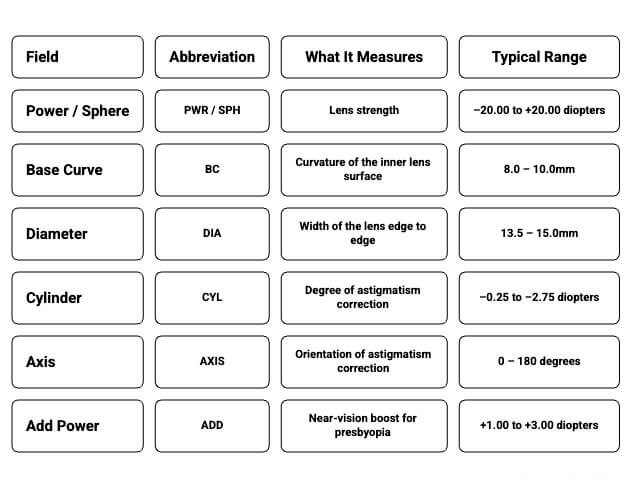
Note: Values outside these ranges exist for high prescriptions and specialty fittings. If your prescription falls outside the typical range, your eye doctor will advise on available lens options.
What Your Prescription Does Not Include
A few things readers commonly expect to see on a contact lens prescription, but won't:
Pupillary Distance (PD): PD is a glasses-only measurement. It records the distance between your pupils to center the optical lens in the frame. Contact lenses center themselves on the cornea, so PD is irrelevant.
Expiration Date: Most prescriptions expire one year from the date of the fitting (two years in some US states). The expiration date may appear on the prescription document itself, but it is not printed on the lens box. Keep your prescription document, you will need it when reordering.
Color or Cosmetic Specifications: If you wear colored contacts, the color is a separate selection at the point of purchase. It does not appear on the prescription unless it affects the optical zone.
How Long Is a Contact Lens Prescription Good For?

In most U.S. states, a contact lens prescription expires one year from the date it was issued. Some states permit a two-year validity period, but one year is the standard.
The annual renewal requirement is not arbitrary, eyes change over time. A prescription that fit correctly 18 months ago may no longer match your corneal curvature or vision needs today. Annual exams also allow your doctor to check for signs of lens-related complications, corneal hypoxia, dry eye, or early-stage conditions that are far easier to address when caught early.
An expired prescription cannot be used to place a legal order for contacts in the US. Retailers are required to verify the prescription before shipping. If a prescription has lapsed, schedule a contact lens exam and fitting before ordering.
For existing wearers who have been putting off their annual exam, it is worth noting that lifestyle factors ranging from screen time to sleep habits affect vision more than most people realize. In just 20 minutes, the information it provides is worth far more than the time lost.
Key Terms Beyond the Prescription
These terms appear on lens packaging, product pages, and doctor's notes. None of them appear on the prescription itself, but they inform the choices made when selecting a lens.
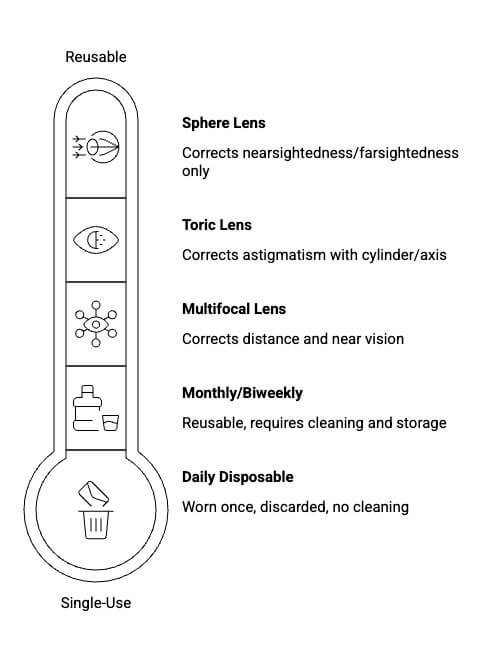
When comparing lenses, oxygen permeability and water content matter most for comfort and eye health over the course of a full day's wear. Higher Dk/t values are especially relevant for extended wear schedules and for anyone who spends long hours in front of screens.
Ready to Order?
People considering contacts for the first time should start with a contact lens exam and fitting from a licensed eye doctor. If you already have a prescription and are looking to upgrade: PerfectLensWorld carries a wide selection of daily, monthly, toric, and multifocal lenses from the brands that eye doctors know and trust, fast shipping, and a straightforward ordering process.
Stop straining your eyes, carrying a bulky glasses case, and delaying the inevitable. Find out your eligibility, get the right prescription, visit our collection of contact lenses and sunglasses, and see the world in a whole new light. It’s that simple.
Disclaimer
Always follow your eye doctor's guidance on lens wear schedules, care routines, and replacement timelines. This glossary is for educational purposes and does not constitute medical advice.

