


Buying Contact Lenses for the Whole Family Made Simple

Vision correction is personal. A teenager heading into sophomore year has completely different needs than a parent who has been wearing monthly lenses for a decade, or a grandparent navigating presbyopia. Buying contact lenses for the whole family sounds like a logistical headache, but with the right approach, it can actually be straightforward, affordable, and even a little satisfying.
This guide covers everything a household needs to know: what age kids can start wearing contacts, how to pick the right lens type for each family member, and how to buy contact lenses online in a way that saves real money.
Can Kids Wear Contact Lenses? Here Is What Eye Doctors Say
It is one of the most common questions parents ask at eye appointments, and the answer might be more flexible than expected. There is no universal minimum age for contact lenses. Instead, eye care professionals look at something more meaningful: maturity.
The American Academy of Ophthalmology notes that contact lenses can correct vision for a range of refractive errors, including nearsightedness, farsightedness, astigmatism, and the near-vision changes that come with age.
That broad range means lenses are an option for the young and the not-so-young alike. The key question for children is not how old they are, but whether they are ready.
Most eye doctors begin recommending contacts between the ages of 11 and 12 for children who show a consistent ability to follow hygiene routines. Some children are ready earlier, around age 8 to 10, particularly when daily disposable lenses are used, and a parent is closely involved. Others may not be ready until their mid-teens, but neither scenario is unusual.
Signs a child may be ready for contacts:
- Completes personal hygiene tasks independently and consistently.
- Follows household rules without frequent reminders.
- Take good care of belongings, including eyeglasses if worn.
- Can tolerate touching near their eyes without significant discomfort.
- Understands and can repeat back care instructions.
Age and Readiness Reference Chart
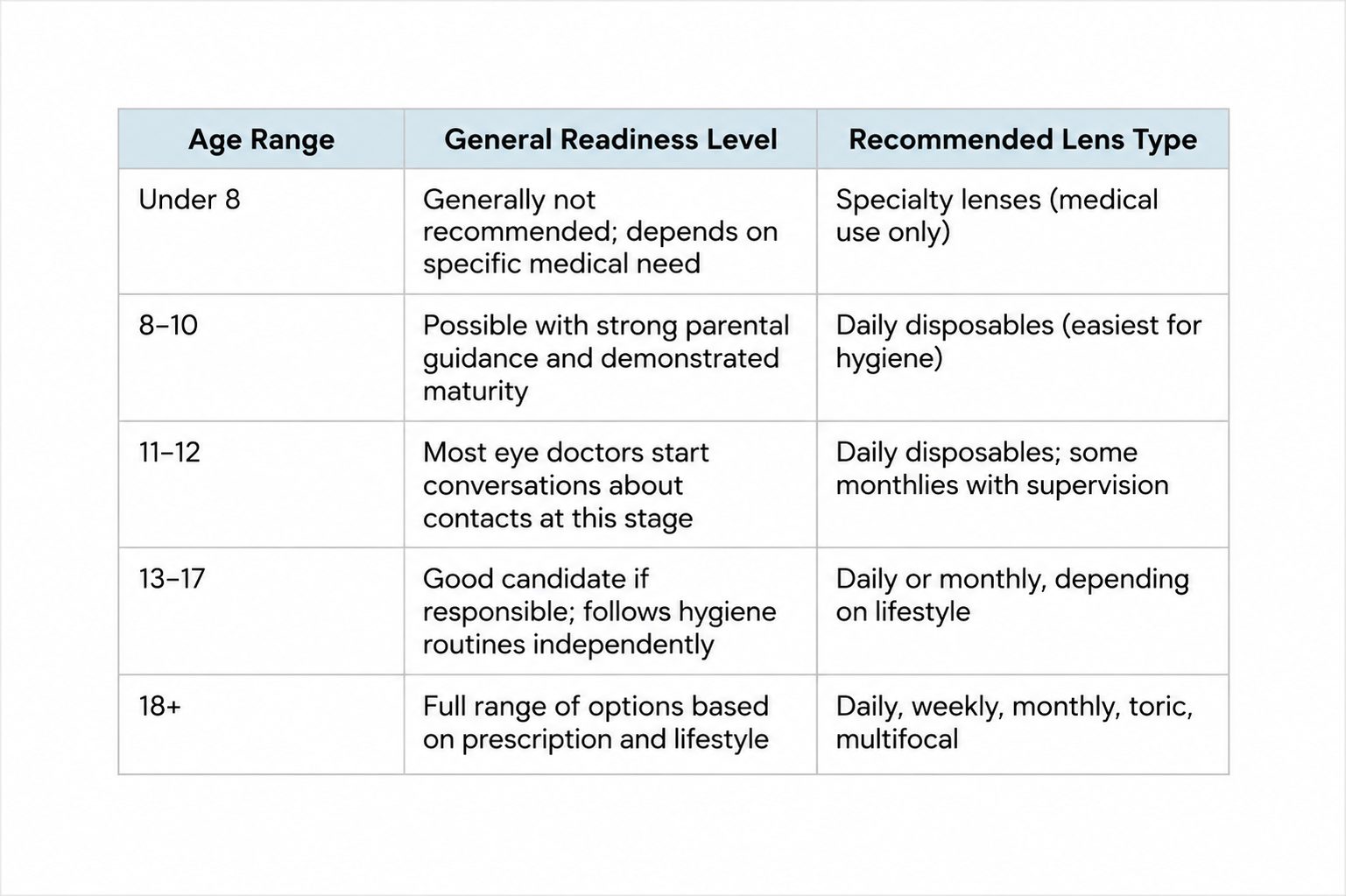
It is worth noting that the conversation between a parent and an eye doctor is the most important step. A contact lens fitting for a child requires a separate exam from a standard glasses prescription, and an eye care professional can assess corneal shape, lens fit, and comfort before any purchase is made.
Once a child gets the green light and a valid prescription, ordering online is fast, straightforward, and significantly more affordable than buying through a doctor's office.
Daily Contact Lenses vs Monthly: Matching the Right Lens to the Right Person

Not every family member needs the same type of contact lenses, and understanding the difference between daily and monthly contacts makes buying for multiple people far less overwhelming. Think of it like choosing shoes: the right fit depends on how often someone wears them, what they are doing in them, and how much upkeep they are willing to commit to.
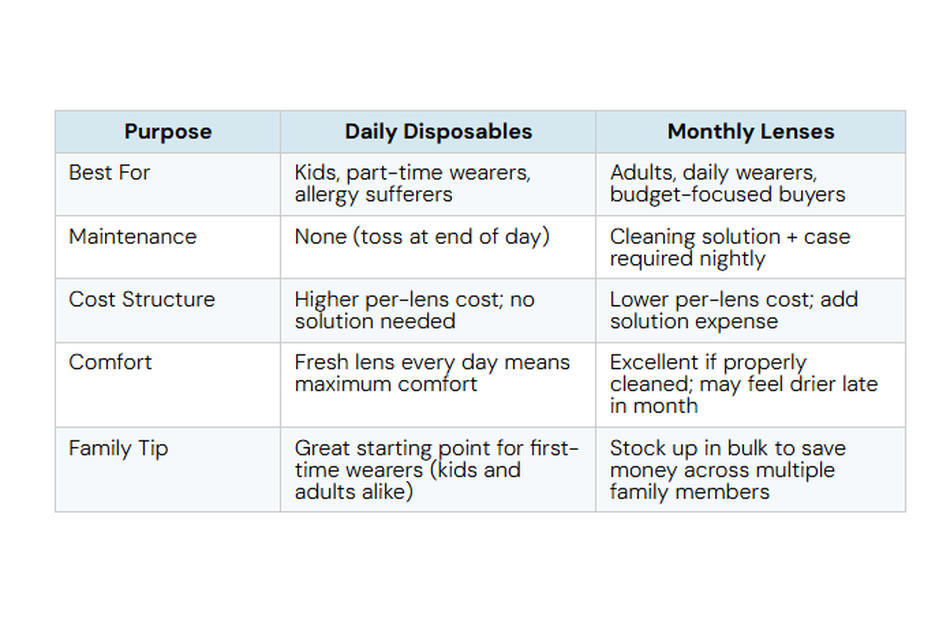
Daily vs. Monthly Lenses: Quick Comparison
Daily Disposables: The Low-Maintenance Choice
Daily disposable lenses are exactly what they sound like. Wear them once, discard them at the end of the day, and start fresh tomorrow. No cleaning solution. No case. No wondering if the lenses were properly stored the night before. For first-time contact wearers, particularly kids and teenagers, daily disposables remove a significant layer of complexity from the routine.
They also tend to be better for people with allergies or dry eyes because there is no opportunity for protein deposits to build up on the lens surface. The trade-off is cost: daily disposables cost more per lens than monthlies.
Monthly Lenses: The Budget-Smart Option for Regular Wearers
Monthly contact lenses are designed to be worn every day for up to 30 days, then replaced. They require a nightly cleaning and storage routine using contact lens solution and a case. For adults who wear contacts every single day and are comfortable with the care routine, monthly lenses typically offer the lowest per-lens cost over the course of a year.
Specialty Lenses: Toric and Multifocal Options for the Whole Family
Not every prescription is standard. Toric lenses correct astigmatism, a condition where the eye is shaped more like a football than a sphere, which causes blurry or distorted vision at multiple distances. Multifocal lenses address presbyopia, an age-related vision change that typically starts after age 40. Both types are available in daily and monthly formats.
If someone in the household has astigmatism or wears bifocals, their lens options are not as limited as they might think.
With a clear picture of who in the family needs what type of lens, the next step is figuring out how to buy smarter, not just cheaper.
How to Buy Contact Lenses Online and Save Money
Buying contact lenses online is legal, safe, and affordable. The process requires a valid, unexpired contact lens prescription for each person placing an order. That prescription is separate from an eyeglasses prescription and comes from a contact lens exam and fitting. Once that paperwork is in hand, the savings begin.
Consolidate Orders to Hit Free Shipping
One of the simplest ways to save on a family order is to consolidate everything into a single transaction. Instead of placing separate orders for each family member and going to pick up lens orders on different days, gathering all prescriptions and adding everything to one cart saves on shipping and reduces the number of boxes arriving at the door.
Use FSA and HSA Funds Before They Expire
Prescription contact lenses are a qualified medical expense under IRS rules. That means FSA (Flexible Spending Account) and HSA (Health Savings Account) funds can cover the cost. Using pre-tax dollars effectively delivers a 20% to 30% discount, without requiring any coupons or promo codes.
FSA funds typically expire on Dec. 31 of the plan year, making the fall and early winter a great time to stock up on contacts before that money disappears. HSA funds roll over year to year, so there is no deadline pressure, but using them for a predictable annual expense like contacts is smart financial planning regardless of timing.
Stacking these strategies, consolidating shipments, buying in bulk, and using pre-tax accounts, is how families squeeze the most value out of every order. The next step is knowing how to place one.
How to Place a Family Contact Lens Order
Placing a contact lens order for multiple people sounds complicated. It is not. The process works the same way for one person as it does for five. Here is how to move through it efficiently.
Ordering Contact Lenses Online
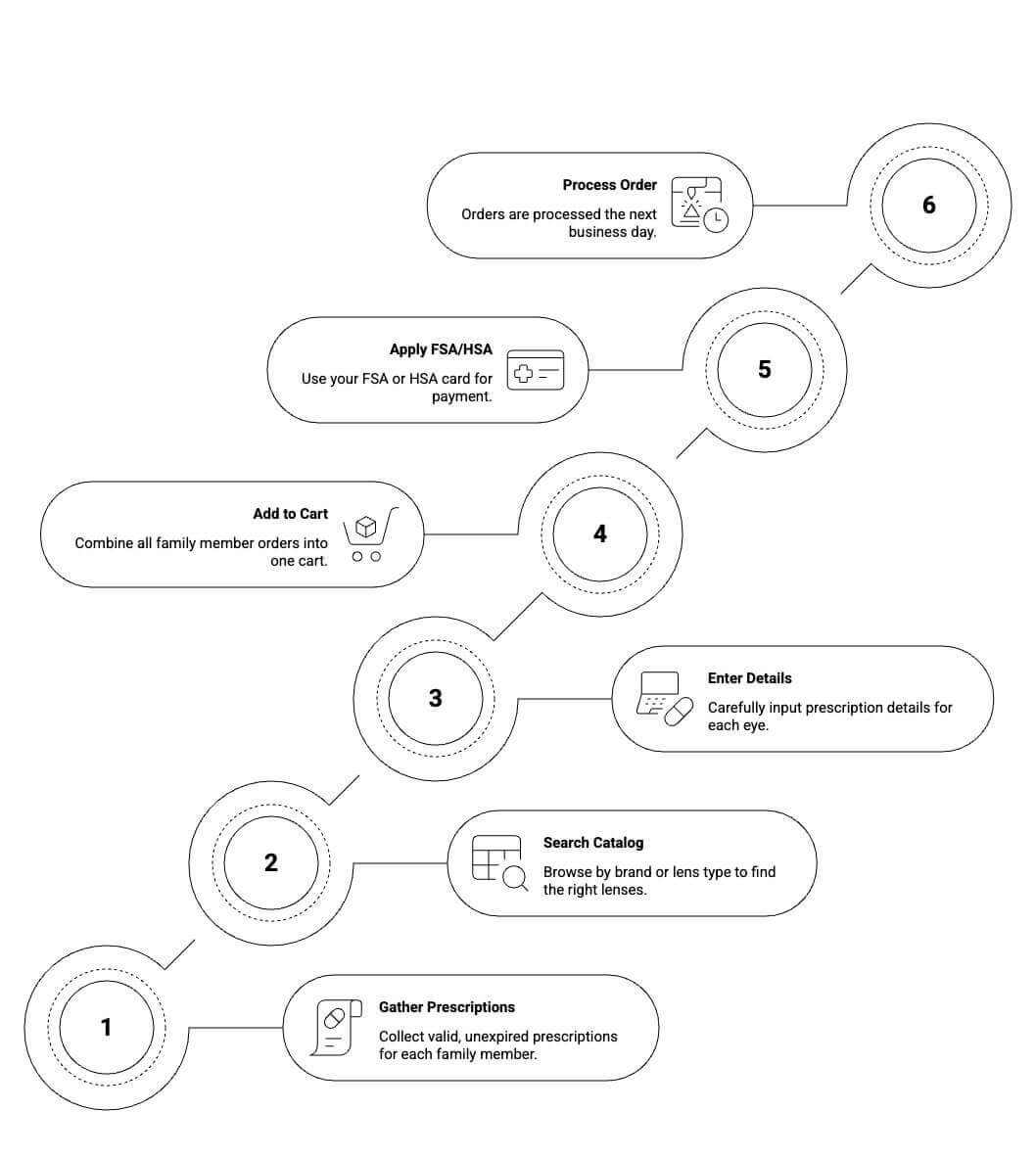
- Gather all prescriptions. Each family member needs a valid, unexpired contact lens prescription that includes the brand, power, base curve, and diameter. If prescriptions have expired, scheduling eye exams before ordering is necessary.
- Search by brand or browse by lens type. PerfectLensWorld organizes its catalog by brand (Acuvue, Air Optix, Dailies, CooperVision, Bausch + Lomb, and more) and by type (daily, weekly, monthly, toric, multifocal, color). Both routes make it easy to find the right product.
- Enter each prescription carefully. Prescription details matter. Double-check power (sphere), base curve, and diameter for each eye. For toric lens wearers, also confirm cylinder and axis values from the prescription card.
- Add all items to the cart before checking out. Combining all family member orders into one cart is the simplest way to hit the free shipping threshold and keep delivery in one convenient package.
- Apply FSA or HSA card at checkout. Use the card like any standard debit card in the payment field. No special codes or forms are required for most purchases.
- Orders process next business day. PerfectLensWorld processes most orders the next business day, which means fresh lenses arrive at the door faster than many people expect.
Reordering is even faster after the first purchase. Prescription details are already saved in the account, making future orders a matter of a few clicks rather than re-entering everything from scratch.
Contact Lens Care Basics Every Family Member Should Know

Great lenses only pay off when they are worn and cared for properly. Whether the wearer is a 12-year-old starting out or a 45-year-old who has been wearing contacts for decades, a few habits make the difference between healthy eyes and preventable problems.
The American Academy of Ophthalmology recommends these core practices for safe contact lens use:
- Always wash and dry hands thoroughly before handling lenses
- Never rinse lenses with tap water or saliva
- Use the "rub and rinse" method with cleaning solution before soaking monthly lenses, even if the solution bottle says "no-rub"
- Never sleep in daily wear lenses
- Replace lens cases every three months and never top off old solution
- Remove lenses immediately if eyes become red, painful, watery, or unusually sensitive to light
For families with children, it helps to build these habits into an existing routine. Linking lens care to teeth brushing at night is one of the simplest ways to make it stick.
Proper care extends the comfort and lifespan of each pair of lenses and keeps eye health squarely on track for every member of the household.
Ready to Stock Up? Browse PerfectLensWorld
Ordering contact lenses for the whole family does not have to mean separate trips, separate shipping charges, or retail markup on every box. PerfectLensWorld makes it straightforward to find the right lenses for every prescription, consolidate the order, and get everything delivered the next business day.
Browse our Collection of daily, monthly, toric, multifocal, and color contact lenses from the brands the whole family trusts. Sunglasses and lens care accessories are also available, making PerfectLensWorld a one-stop shop for household vision needs.

