


Understanding How Contact Lenses Work for Astigmatism

Astigmatism is a common refractive condition caused by an irregular curvature of the cornea or lens. Standard contact lenses typically correct nearsightedness or farsightedness, but astigmatism and contacts require a lens designed to address uneven focus. Modern technology makes it possible with a clear, stable vision that doesn’t require solely relying on eyeglasses.
Let’s unlock the difference in lens designs and how toric and other specialized contact lenses for astigmatism are built to maintain alignment and deliver consistent visual clarity throughout the day.
What Is Astigmatism?
Astigmatism affects how light enters and focuses within the eye. Instead of a smooth, evenly curved surface, the cornea or lens has mismatched curves that bend light unevenly.
The American Academy of Ophthalmology states that astigmatism is a common condition that causes blurred vision because the surface of the eye has an egg shape rather than a round one (American Academy of Ophthalmology, 2023).
That uneven curvature prevents light from focusing at a single point on the retina. Because the eye has two distinct curves, light rays focus at multiple points instead of one. The result is blurred or distorted vision at all distances. Headaches and eye strain may develop after prolonged reading or screen use.
Astigmatism reflects a structural difference in eye shape. With proper correction, vision can be sharpened effectively using glasses or contact lenses.
Astigmatism vs Normal Vision
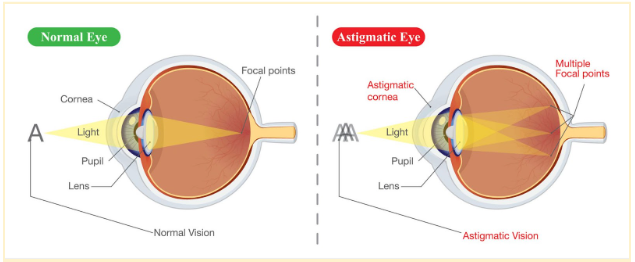
Comparing astigmatism vs normal vision clarifies why specialized correction is required. In a typical eye, the cornea is round, allowing light to converge at a single focal point on the retina. Images appear sharp and well defined.
With astigmatism, the cornea resembles a football rather than a basketball. Light refracts unevenly and creates multiple focal points. Images may appear stretched, shadowed, or slightly doubled.
This difference becomes more noticeable in low-light conditions. Astigmatism at night driving can involve glare, halos, or streaking around headlights and streetlights. Pupil dilation in darker environments increases the amount of peripheral light entering the eye, which can intensify distortion if correction is not precise.
How light behaves in each scenario explains why lens orientation matters as much as lens power.
Can You Wear Contacts With Astigmatism?

A frequent question is, can you wear contacts with astigmatism? In most cases, yes. Advances in lens design have made contact lenses for astigmatism widely accessible across a broad range of prescriptions.
Standard spherical lenses contain a single power and can rotate freely on the eye. For an asymmetrical cornea, that movement can cause inconsistent clarity.
Contacts for astigmatism are designed to remain aligned with the eye’s specific curvature. During an eye exam, measurements determine both the strength of correction and the axis, which indicates the orientation of the irregular curve. These details guide lens selection.
With accurate fitting and follow-up adjustments when needed, contacts can deliver stable correction comparable to glasses, often with a wider field of view.
How Toric Contact Lenses for Astigmatism Work
Toric contact lenses for astigmatism are built with multiple corrective powers in different meridians of the lens. This structure accounts for the uneven way light enters an asymmetrical eye.
Because alignment is necessary for clear vision, toric lenses incorporate stabilization features that limit rotation.
Common design approaches include:
- Thin and thick zones that interact with eyelid pressure to guide positioning
- Ballasting that adds subtle weight to maintain upright orientation
- Lens truncation that creates a flatter edge to rest along the lower eyelid
These features help maintain consistent focus during blinking, head movement, and visual shifts. Stable orientation is especially important during tasks such as night driving, where glare and distortion are more noticeable.
The added structural detail explains why toric lenses require precise fitting. Once positioned correctly, they provide steady, predictable clarity.
Spherical vs Toric Lenses: More Than Meets the Eye
Understanding the structural differences between standard lenses and toric lenses simplifies product comparisons. The visual below outlines the primary distinctions.
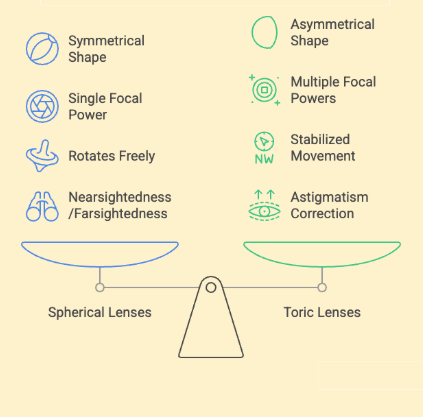
A structured overview supports clearer evaluation before a final prescription is selected.
Types of Contact Lenses for Astigmatism
Several contact lens types address different prescription strengths and comfort preferences. Material, replacement schedule, and eye shape all factor into the selection process.
Soft Toric Lenses
These lenses are designed for flexibility and daily comfort. They are available in daily, biweekly, and monthly replacement schedules. Soft toric lenses are often the first option prescribed due to their adaptability and ease of wear.
Rigid Gas Permeable (RGP) Lenses
These lenses maintain their shape on the eye, which can provide sharper optics for moderate to higher levels of astigmatism. Their firm structure allows light to refract more predictably across the lens surface.
Hybrid Lenses
Hybrid designs combine a rigid center with a soft outer skirt. This structure aims to deliver the optical clarity of rigid lenses with the comfort profile of soft materials.
Scleral lenses
Scleral lenses are larger in diameter and rest on the white part of the eye rather than directly on the cornea. They are often prescribed for irregular corneas or more complex cases of astigmatism.
Each lens category addresses a specific visual need. In the end, selection depends on professional evaluation and individual prescription measurements.
Astigmatism Night Driving and Daily Performance

Low-light environments often highlight undercorrected astigmatism. Glare, halos, and streaked lights can reduce clarity and contrast.
Properly fitted contact lenses for astigmatism align correction with the eye’s curvature, which can reduce distortion and improve stability in darker settings. Consistent lens care and routine eye exams also support reliable daily performance.
If night glare or fluctuating vision persists, reassessment of lens fit or prescription strength may be necessary.
Clear vision in both daylight and nighttime conditions depends on accurate correction and lens stability.
Choosing the Right Contacts for Astigmatism
Astigmatism results from uneven curvature in the cornea or lens, causing light to focus at multiple points on the retina. Specialized toric lenses correct this by combining multiple powers with orientation control that limits rotation.
Modern contact lenses make it possible for most individuals with astigmatism to achieve stable, comfortable vision. The process begins with precise measurements and a professional fitting.
Explore toric contact lens options by brand and replacement schedule to find a prescription that brings new clarity to your day-to-day vision.

