


How to Keep Your Contact Lens Case Clean and Safe
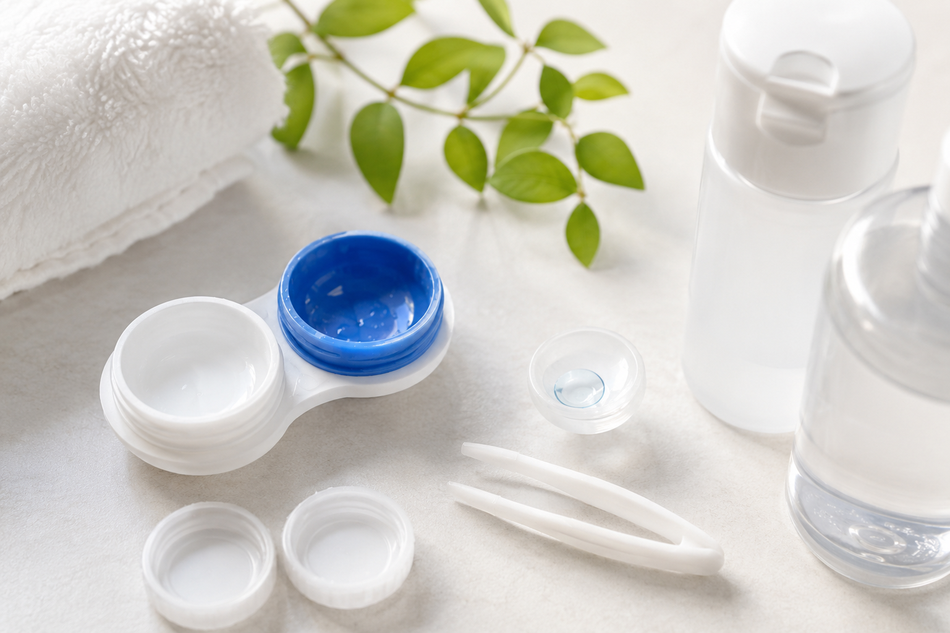
Your contact lens case does more than store your lenses overnight. It is the last line of defense between your eyes and harmful bacteria. If you are not cleaning it correctly, you may be putting your eyes at risk every single morning without knowing it.
This article walks you through the right daily cleaning routine, explains why each step matters, covers the most common mistakes, and tells you exactly when to replace your case.
Why Your Lens Case Is Dirtier Than It Looks
A lens case can look completely clean and still be contaminated. Research published in Optometry and Vision Science found that 66% of contact lens cases tested positive for bacterial or fungal contamination, and nearly 40% of those had multiple organisms present at the same time.
The reason a clean-looking case can still be dangerous comes down to biofilm. Biofilm is a thin, sticky layer of bacteria that forms on the inner walls of the case over time. You cannot see it, and standard rinsing does not fully remove it. Once biofilm establishes itself, it becomes resistant to the disinfecting solution you use to clean the case.
What Lives in a Contaminated Case
The bacteria most commonly found in lens cases include Pseudomonas aeruginosa, Serratia marcescens, and Staphylococcus. None of these are harmless. Pseudomonas aeruginosa is the most frequent cause of contact lens-related microbial keratitis, a painful corneal infection that can permanently damage vision if left untreated.
Anthony Adams, OD, PhD, Editor-in-Chief of Optometry and Vision Science, stated: "Lens cases play an essential role in disinfection of contact lenses. However, without proper maintenance, the lens case itself may become contaminated with micro-organisms during handling."
How to Clean Your Contact Lens Case the Right Way
Cleaning your case takes less than two minutes and should happen every morning after you put your lenses in. This six-step routine, done consistently, significantly reduces contamination risk.
- Wash your hands with soap and water before touching the case. Dry them with a clean, lint-free towel.
- Put your lenses in your eyes as normal.
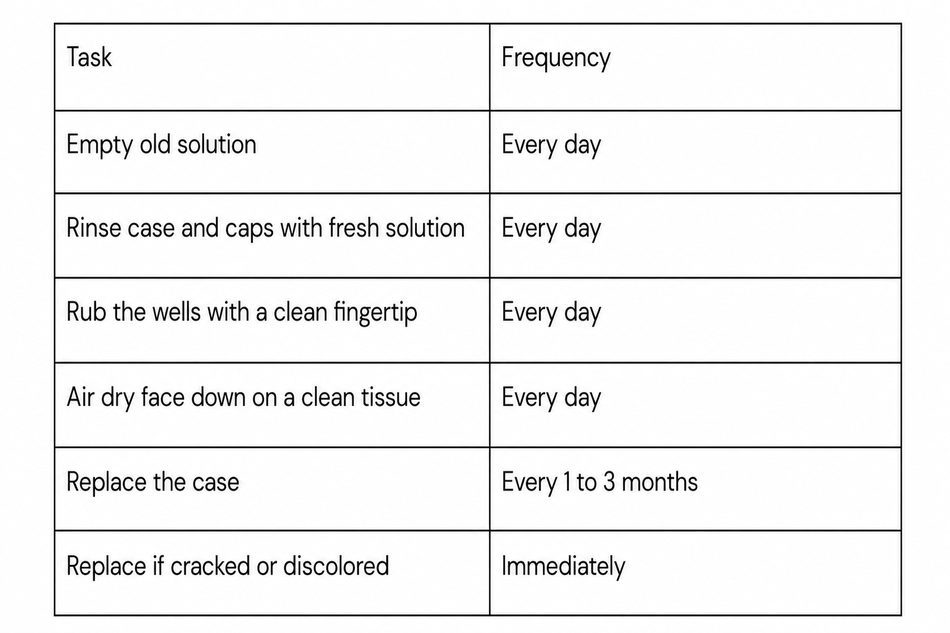
- Empty any remaining solution from the case completely. Never reuse old solution.
- Rinse each well and both caps with fresh contact lens solution. Do not use tap water.
- Gently rub the inside of the wells with a clean fingertip and a few drops of fresh solution.
- Shake out the solution and place the case open, face down, on a clean tissue to air dry.
The American Academy of Ophthalmology recommends rinsing with sterile contact lens solution and letting the empty case air dry with the caps off after each use. The American Optometric Association specifies that the case should be stored open and dry between cleanings.
Why Air Drying Matters
Towel drying introduces lint fibers and bacteria directly into the case. Air drying face down allows any remaining liquid to drain out and keeps the interior protected from airborne particles. This is a small step with a real impact on how clean your case stays between uses.
A Note for Hydrogen Peroxide Users
If you use a hydrogen peroxide-based system such as Clear Care, your routine differs from standard multipurpose solution care. These systems use a special neutralizing case that converts hydrogen peroxide to saline over six to eight hours. Do not rub or manually rinse the inside of that case the way you would a standard case. Follow the product instructions exactly. Hydrogen peroxide cases should also be replaced every 90 days because the neutralizing disc inside loses effectiveness over time.
Why Tap Water Is Never Safe for Lens Cases
Tap water contains microorganisms that can survive in your lens case and cause serious eye infections. One of the most dangerous is Acanthamoeba, a waterborne organism that causes Acanthamoeba keratitis, a corneal infection that is difficult to treat and can result in permanent vision loss.
The CDC is clear that tap water should never contact lenses or lens cases. This applies even if you live somewhere with high-quality drinking water. Tap water meets drinking standards, not sterility standards. It still contains low levels of microorganisms that are harmless in your stomach but dangerous in your eye.
Do not rinse your case with tap water, do not store your lenses in tap water, and do not use saliva as a substitute for solution.
How Often to Replace Your Lens Case
Replace your lens case every one to three months, even if you clean it every day. The AOA recommends replacement at least every three months. Many manufacturers suggest monthly replacement, which is more consistent with what clinical research supports.
The reason daily cleaning alone is not enough comes back to biofilm. Over months, a microscopic layer of resistant bacteria builds up on the case walls. Cleaning solution cannot fully penetrate it, regardless of how often you rinse.
The data on actual replacement habits is striking. According to a CDC survey, 82.3% of contact lens wearers reported replacing their cases less often than recommended. Research cited by Review of Contact Lenses found that without clear guidance, only 26% of patients replaced their case within one month. Nearly 50% waited five months or longer, and 10% never replaced it at all.
The Easiest Replacement Reminder
Most contact lens solution bottles include a new case in the packaging. Use that as your replacement trigger. Every time you open a new bottle of solution, swap out your old case for the one that came with it. This removes the need to track dates and builds the habit automatically.
Replace the case right away if you notice any cracks, discoloration, or visible buildup, regardless of when you last replaced it.
Where You Store Your Case Matters
Most wearers keep their lens case in the bathroom, which is one of the riskier spots for it. Bathrooms are humid, and every toilet flush sends a fine aerosol of particles into the air, a phenomenon known as toilet plume, which can settle on surfaces across the room, including your vanity.
A better storage option is a bedroom dresser or nightstand, away from direct moisture. Leave the case open with lids off while it dries, then close it only once the inside is fully dry.
The Most Common Lens Case Mistakes
Most lens case hygiene problems trace back to a handful of repeated habits. If your eyes have been red or irritated recently, one of these may be the cause.
- Topping off solution: Adding fresh solution on top of old solution dilutes the disinfectant and allows bacteria to survive. The CDC identifies topping off as a documented risk behavior. Always empty the case fully and refill with fresh solution.
- Rinsing with tap water: Introduces Acanthamoeba and other waterborne organisms directly into the case.
- Wiping the case dry with a towel or tissue: Transfers bacteria and lint fibers into the wells. Air dry face down instead.
- Skipping the lids: The inside of the caps harbor bacteria the same way the wells do. Rinse and air dry the lids every time.
- Keeping the same case too long: Even with correct daily cleaning, biofilm builds up over months. Replace every one to three months.
- Handling the case with unwashed hands: Bacteria from your fingertips transfer directly into the case during handling.
When Daily Disposable Lenses Make More Sense
If managing case hygiene consistently feels difficult, daily disposable lenses remove the problem entirely. You wear a fresh pair each day and discard them that night. No case, no solution, no cleaning routine.
Daily disposables are worth considering if you have had recurring eye irritation or infections linked to lens care, or if you wear lenses only part of the time and find it hard to maintain a consistent cleaning routine.
PerfectLensWorld carries daily disposables from brands including Acuvue, Dailies, and Bausch and Lomb. If you wear toric or multifocal lenses, daily options are available for those prescriptions as well.
Daily Case Care at a Glance
Protect Your Eyes With a Routine That Actually Works
This article covers general hygiene guidance based on recommendations from the American Academy of Ophthalmology, the American Optometric Association, and the CDC. Your eye care provider may have specific instructions based on your lens type, solution, and eye health. Contact lenses are regulated by the FDA as medical devices, and proper care is essential to safe wear.
If your eyes are red, painful, watery, or sensitive to light, remove your lenses and contact your eye doctor right away. These can be signs of an infection that needs prompt attention.

