


The History of Contact Lenses and How Far We've Come
Contact lenses are one of the most personal pieces of technology most people use every day. Around 45 million Americans wear them, yet very few know how dramatically different they are from what they started as. Early contacts were made from blown glass, covered the entire eye, and could only be worn for a few hours before pain forced wearers to remove them.
This article walks through the full story of contact lens development, from the earliest concepts in the 1500s to the breathable, specialty lenses available today. By the end, you will understand why today's lenses feel so different, what the most important breakthroughs were, and what options now exist for nearly every vision need.
The First Ideas: Vision Correction Before the Modern Lens
The concept of placing something on the eye to correct vision dates back to 1508, when Leonardo da Vinci sketched a design showing how submerging the eye in water could change how it focused light. That sketch did not produce a wearable lens, but it introduced the core idea that the corneal surface could be used to correct vision. It took nearly 400 more years before anyone made a lens that worked.
Da Vinci's sketches described a water-filled glass dome worn over the eye. The concept was theoretically sound but completely impractical. In 1636, French philosopher René Descartes refined the idea by describing a glass tube filled with liquid held against the cornea. His design removed the need to submerge the whole eye, which was progress, but pressing a glass tube against your face by hand was not a workable solution.
The 1800s: From Theory to Glass
Progress came slowly through the 19th century. In 1801, British scientist Thomas Young built a crude prototype by waxing water-filled lenses directly to his own eyes to test the theories of da Vinci and Descartes. In 1827, British astronomer Sir John Herschel proposed the idea of making a mold of a person's eye so that lenses could conform closely to the corneal shape, a concept well ahead of its time.
The first actual contact lenses arrived in 1887, when German glassblower F.A. Muller manufactured a glass shell designed to cover the entire eye. It was not intended to correct vision but to protect a damaged eye. One year later, in 1888, German ophthalmologist Adolf Eugen Fick fitted the first glass lenses that corrected vision. Fick's lenses were blown from heavy glass, roughly 18 to 21 mm in diameter, and sat on the entire eye surface including the sclera (the white of the eye). They were filled with a dextrose solution to reduce friction. Wearers could only tolerate them for a few hours before pain and oxygen deprivation forced them out.
That oxygen problem would drive contact lens development for the next 100 years.
The Plastic Era: Lighter, Smaller, and Longer Wearing
The 1930s marked the shift from glass to plastic, bringing with it the first lenses people could realistically wear for a full day. In 1936, New York optometrist William Feinbloom introduced scleral lenses made from a glass-plastic hybrid. The plastic skirt was lighter and gentler on tissue than all-glass designs. By 1938, researchers Obrig and Mullen developed the first fully plastic scleral lenses using polymethyl methacrylate (PMMA), a clear and lightweight material that became the standard for rigid lenses.
PMMA lenses were a meaningful improvement over glass. They were lighter, more durable, and easier to manufacture. But they still had one fundamental flaw: PMMA did not allow oxygen to pass through the lens to the cornea.
Corneal Lenses: Covering Less of the Eye
In 1948, California optician Kevin Tuohy patented the first corneal contact lenses. These were smaller than scleral lenses and sat only on the cornea rather than the entire eye surface. Because they were smaller, they moved with each blink, allowing oxygen-carrying tears to circulate underneath. Properly fitted PMMA corneal lenses could be worn for 16 hours or more, making them the first lenses that worked as a realistic daily option for most people.
PMMA corneal lenses became widely used through the 1950s and 1960s. They were rigid, which produced sharp vision correction, but they required a careful fitting process and a significant break-in period. Many wearers found them uncomfortable, and they were not suitable for everyone.
The Soft Lens Shift: Comfort Changes Everything
The single biggest leap in contact lens history happened on Christmas Eve, 1961, in a small house in Prague. Czech chemist Otto Wichterle built the first prototype wearable hydrogel soft contact lens using a hot plate, a centrifuge, and a spinning device assembled from a gramophone motor, bicycle parts, and his son's construction set. That improvised prototype became the foundation for every modern soft lens.
Wichterle and his colleague Drahoslav Lim had been developing hydrophilic (water-loving) polymers since 1959. Their material absorbed water, making it soft and flexible enough to conform to the shape of the eye without causing pain. Wichterle's patents were eventually licensed to Bausch + Lomb, which launched the first FDA-approved soft contact lens in the United States in 1971 under the name Soflens.
Soft lenses changed the market completely. They were thinner, more comfortable on insertion, and tolerated by far more wearers than rigid PMMA lenses. Today, more than 90 percent of contact lenses prescribed in the United States are soft lenses, a figure that reflects how fully Wichterle's invention reshaped the field.
Extended Wear and the Oxygen Research That Followed
With soft lenses widely adopted, the industry turned to a new goal: enabling longer wear. The FDA cleared hydrogel soft lenses for extended wear in 1981, and by the mid-1980s around 4 million Americans wore them.
Research began revealing the risks of depriving the cornea of oxygen over long periods. The Gothenburg Study demonstrated that extended and continuous wear caused measurable damage to the corneal surface. Separately, researchers Holden and Mertz established the minimum oxygen transmissibility (Dk/t) required to avoid corneal swelling during daily wear. These findings made clear that the next frontier in contact lens design was oxygen delivery through the lens material itself.
Disposable Lenses: Hygiene and Convenience Reshape the Market
The first disposable contact lens was introduced in Denmark in 1982. Daily disposable lenses, designed to be worn once and discarded, became commercially available in 1995. This shift addressed one of the oldest problems in contact lens wear: the gradual buildup of protein deposits and bacteria on reused lenses. A fresh lens each day meant better hygiene, fewer complications, and no cleaning routine for the wearer.
The move toward disposables was driven by research showing that more frequent lens replacement reduced long-term complications. Daily disposables removed the need for cleaning solutions entirely for most wearers. Monthly and two-week replacement schedules offered a middle option for those who preferred a lower annual cost.
Today, daily disposable lenses hold more than 33 percent of the global contact lens market by revenue, and that share continues to grow.
Specialty Lenses Expand Who Can Wear Contacts
The 1970s and 1980s brought lenses designed for specific vision conditions that earlier designs could not address:
- Toric lenses, which correct astigmatism, received FDA approval in 1978.
- Extended-wear lenses were introduced by CooperVision in 1979.
- Bifocal contact lenses for presbyopia (age-related near vision loss) were introduced by Bausch + Lomb and Wesley Jessen in 1981.
- Cosmetic color lenses for non-medical use emerged around 1988.
- Multifocal disposable lenses became available from Bausch + Lomb in 1998.
Each of these expansions widened the pool of people who could find a contact lens that worked for their prescription. Where contacts once addressed mainly myopia and hyperopia, they now covered astigmatism, presbyopia, and cosmetic use as well.
Silicone Hydrogel: The Oxygen Breakthrough
Silicone hydrogel lenses, introduced commercially in 1998 by Ciba Vision, addressed the biggest remaining problem in soft lens wear. Traditional hydrogel lenses relied on their water content to carry oxygen through to the cornea. Silicone hydrogel lenses combine the high oxygen permeability of silicone with the comfort of hydrogel, delivering far more oxygen without requiring a highly hydrated lens.
Silicone allows oxygen to pass directly through the material rather than through water held in the lens. Wearers experience less corneal stress, especially during longer wear periods. The improvement was significant enough that silicone hydrogel lenses were initially approved for extended wear, with some brands cleared for up to 30 days of continuous use.
Second-generation silicone hydrogels refined the material further. Brands like Acuvue Oasys (senofilcon A) and CooperVision Biofinity (comfilcon A) improved wettability and comfort while maintaining high oxygen transmissibility. By 2023, silicone hydrogel lenses accounted for more than 88 percent of contact lens revenue by material, according to Grand View Research.
PerfectLensWorld carries Air Optix, Acuvue Oasys, Acuvue Vita, and Biofinity, all of which use silicone hydrogel materials built on this generation of development.
Modern Specialty Lenses: Handling Complex Prescriptions
Today's contact lens market covers nearly every vision correction need, including conditions that once made contact lens wear impractical. Toric lenses for astigmatism, multifocal lenses for presbyopia, and myopia control lenses for children are all available as comfortable daily or monthly disposable options.
At the 2025 Optometric Management Symposium, optometrist William H. Stephen, OD, outlined the current standard of care for specialty fitting: match the right material to each patient and treat specialty fits as a core clinical skill rather than an exception. The tools to support that approach now exist across most major brands.
Toric Lenses for Astigmatism
Astigmatism occurs when the cornea has an irregular shape, creating two different focal points rather than one. Toric lenses are designed with different corrective powers in different meridians of the lens and include stabilizing features that prevent rotation on the eye. Early toric lenses covered limited prescription ranges. Today, brands like Dailies Total1 for Astigmatism (Alcon) and Biofinity Toric (CooperVision) cover a wide range of prescriptions in both daily and monthly formats.
Multifocal Lenses for Presbyopia
Presbyopia is the age-related loss of near focus that typically begins around age 40. Multifocal contact lenses use concentric ring designs or aspheric optics to provide clear vision at multiple distances. The brain learns to select the correct focal zone for each task. Brands like Air Optix Aqua Multifocal and Acuvue Oasys for Presbyopia have made this correction accessible to a wide range of patients who previously relied on reading glasses over their contacts.
Myopia Control: Lenses That Do More Than Correct
One of the most meaningful recent advances is the development of lenses designed to slow myopia progression in children. CooperVision's MiSight 1 day lens received FDA clearance for myopia control in children aged 8 to 12. A six-year clinical trial showed a 52 percent reduction in axial eye growth compared to single-vision lenses, and a 2025 study in Optometry and Vision Science confirmed no rebound effect after treatment ended.
Myopia affects approximately 33 percent of Americans, with rates rising sharply among younger populations. Lenses that slow progression represent a step beyond vision correction into preventive eye care.
Where Contact Lens Technology Is Heading
Contact lenses are moving into health monitoring and therapeutic delivery. Smart lenses with embedded sensors, drug-delivering lenses for glaucoma management, and AI-assisted fitting tools are all in active development. Orthokeratology (Ortho-K) lenses, worn overnight to reshape the cornea temporarily, are now used for myopia control in children and for adults seeking clear daytime vision without surgery or daytime lenses.
Research efforts are underway to develop biosensor-embedded lenses capable of monitoring intraocular pressure and tear film composition in real time. Drug-dispensing lens platforms have shown clinical promise for glaucoma treatment in early trials. According to the Contact Lens Spectrum 2025 industry report, the global soft contact lens market grew roughly 4 percent year-over-year through 2025, reflecting steady adoption as lens technology continues to widen its clinical scope.
What Today's Lenses Mean for Your Prescription
Every pair of contact lenses available today is the product of more than 500 years of incremental development. The lenses that were once heavy glass shells tolerated for only two hours are now thin, breathable discs that most people forget they are wearing. The options available now cover nearly every prescription type and lifestyle.
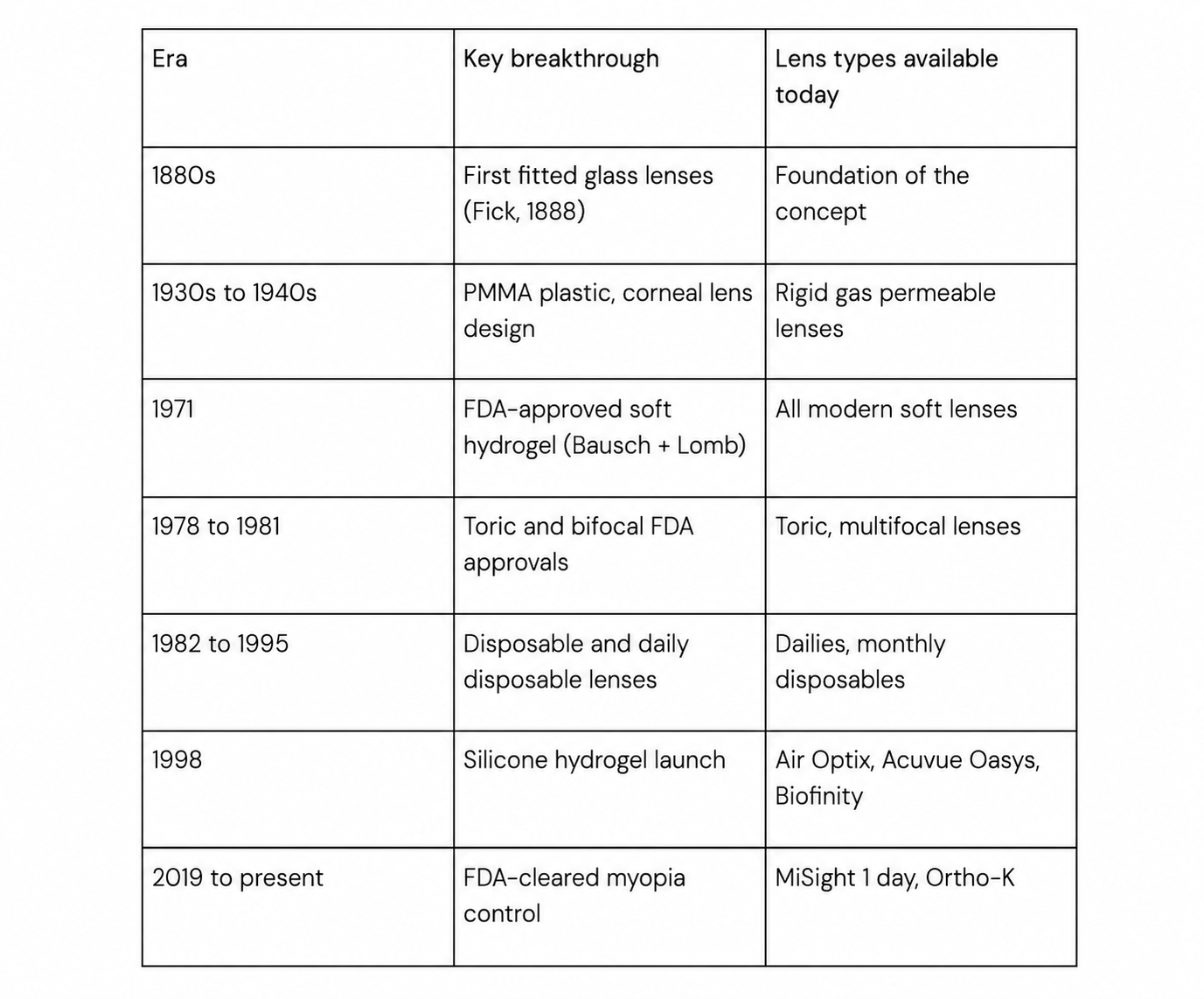
The table below maps each major era to the lens categories that resulted from it:
A few things to keep in mind as you choose your lenses:
- All contact lenses require a valid prescription from a licensed eye care provider.
- Replacement schedules and wear times should follow the manufacturer's instructions and your prescriber's guidance.
- If you have astigmatism or presbyopia and have been told contacts are not a good fit, it is worth discussing modern specialty options with your eye doctor. The available prescriptions and materials have changed significantly in the past decade.
If you know your prescription, browse the full contact lens catalog at PerfectLensWorld to find the right lens at the right price.
Frequently Asked Questions
When were contact lenses invented?
The first glass contact lenses that corrected vision were fitted by German ophthalmologist Adolf Eugen Fick in 1888. The concept dates back to Leonardo da Vinci's sketches in 1508, but those were theoretical. The first modern soft contact lens was developed by Otto Wichterle in 1959 and commercially launched in the US by Bausch + Lomb in 1971.
When were soft contact lenses introduced?
Czech chemist Otto Wichterle developed the first hydrogel soft contact lens material in 1959. Bausch + Lomb launched the first FDA-approved soft contact lens in the United States in 1971 under the brand name Soflens.
When were daily disposable contacts invented?
The first disposable contact lens was introduced in Denmark in 1982. Daily disposable lenses, designed to be worn once and discarded, became commercially available in 1995.
What are silicone hydrogel lenses?
Silicone hydrogel lenses combine the high oxygen permeability of silicone with the comfort of traditional hydrogel. They pass significantly more oxygen through to the cornea than standard soft lenses. Introduced commercially in 1998, they now account for more than 88 percent of contact lens revenue by material globally.
Can people with astigmatism or presbyopia wear contact lenses?
Yes. Toric lenses for astigmatism have been available since FDA approval in 1978, and multifocal lenses for presbyopia since 1981. Both have improved significantly in comfort, prescription range, and availability. Talk to your eye care provider about whether a specialty lens fits your prescription.

