


Eye Floaters: What They Are, What Causes Them, and When to See a Doctor

Spots, threads, cobwebs, tiny rings: shapes like these drifting across the field of vision are almost always eye floaters. Most people notice them at some point in their lives, and for the majority, they are a harmless feature of aging rather than a warning sign.
Knowing what they are, what triggers them, and when to act can mean the difference between peace of mind and a missed diagnosis.
What Are Eye Floaters?
Eye floaters are small, shadowy shapes that appear to drift across the field of vision. They can look like specks, dots, squiggly lines, threadlike strands, cobwebs, or small rings, and they move whenever the eye moves. When someone tries to look directly at a floater, it tends to skitter away, only to drift back into view moments later.
Despite appearing to float in front of the eye, floaters are actually inside it. They form in the vitreous, the clear gel-like fluid that fills the interior of the eyeball and maintains its shape. When tiny clumps or strands form within the vitreous, they cast shadows on the retina, the light-sensitive tissue at the back of the eye, and those shadows are what a person perceives as floaters.
Floaters show up most clearly against plain, bright backgrounds: a clear sky, a white wall, or a sunlit page. They tend to be more prominent in strong light and less obvious in low-light settings. Knowing this distinction helps separate true eye floaters from other visual disturbances that may call for a different kind of attention.
What Causes Eye Floaters?
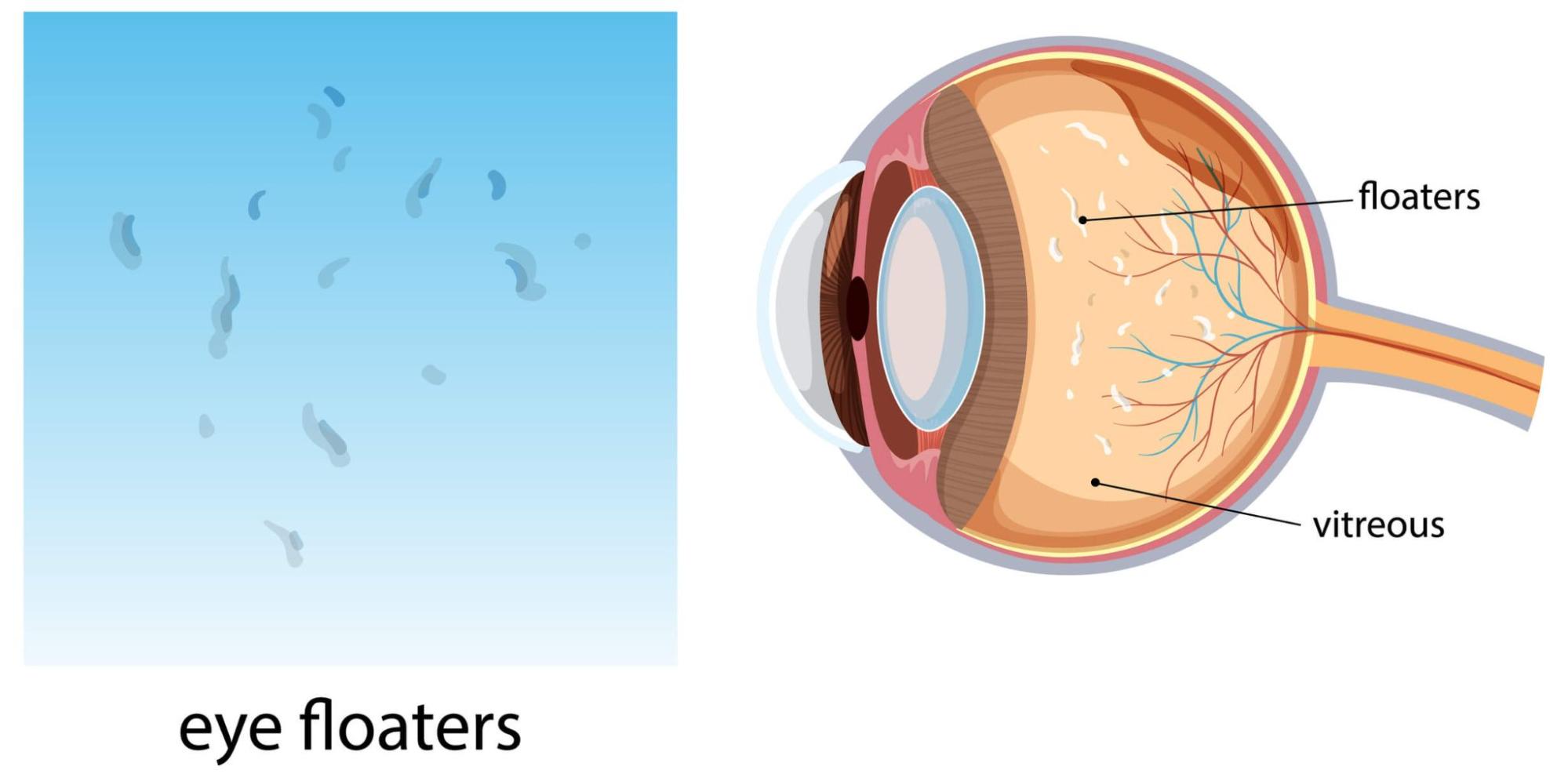
The most common cause of eye floaters is a natural, age-related change in the vitreous. In younger eyes, the vitreous is a firm, cohesive gel. Starting around age 50, it begins to liquefy and shrink. As it pulls away from the back of the eye, tiny collagen fibers within it clump together and cast the shadows that become visible as floaters.
When the vitreous pulls completely away from the retina, the event is called a posterior vitreous detachment (PVD). PVD is common and, in most cases, harmless. A sudden shower of new floaters can indicate that the vitreous is pulling on the retina rather than separating cleanly, a situation that warrants prompt evaluation from an eye doctor.
Beyond aging, several other conditions can cause or accelerate floaters:
- Nearsightedness (Myopia): People with moderate to high myopia tend to develop floaters earlier in life. The elongated shape of a myopic eye places added tension on the vitreous, making the gel more prone to early degeneration.
- Eye Trauma: A direct injury to the eye can disrupt the vitreous and introduce debris, leading to new floaters.
- Cataract Surgery: Post-surgical changes inside the eye can cause floaters to develop or increase.
- Diabetic Retinopathy: In advanced stages, diabetes can cause bleeding inside the eye. Blood cells that enter the vitreous appear as dark floaters or a reddish haze.
- Eye Inflammation (Uveitis): Inflammatory conditions affecting the middle layer of the eye can release cells and debris into the vitreous, which then appear as floaters.
- Retinal Tears: When the vitreous tugs forcefully on the retina and creates a tear, fragments of retinal tissue can enter the vitreous. This typically produces a sudden burst of new floaters, often alongside flashes of light, and requires immediate medical attention.
Contact lens wearers should note that floaters originate inside the eye, not on or near the lens surface. A floater will not wash away with lens solution or clear up after removing contacts. Something that drifts from view when contacts come out is far more likely to be surface debris on the lens itself. Annual dilated eye exams remain the most reliable way to monitor vitreous health over time.
Do Eye Floaters Go Away?
Most eye floaters do not disappear entirely, but they become significantly less noticeable over time. After forming, floaters tend to slowly settle toward the lower portion of the vitreous, drifting out of the central field of vision. The brain also adapts: the visual system gradually learns to filter out the shapes, and many people stop registering their floaters even though the floaters themselves have not changed.
For people who develop floaters after a posterior vitreous detachment, meaningful improvement typically arrives within three to six months as the vitreous stabilizes. A large floater positioned near the center of the visual field can take longer to fade. In those cases, patience and consistent eye monitoring are the practical course.
The floaters themselves represent permanent structural changes in the vitreous. They do not dissolve or disappear on their own. What improves is the brain's learned ability to filter them out and, over time, their physical drift away from the center of vision. For most people, that combination makes a meaningful difference in daily comfort without any medical intervention.
How to Get Rid of Eye Floaters

For the vast majority of people, no treatment is required. Floaters are a nuisance, and the natural adaptation process is the only management most cases ever need. For those whose floaters are severe, persistent, and meaningfully impairing daily life, two medical options exist.
Laser Vitreolysis (YAG Laser)
A focused laser is directed at large floaters to break them into smaller, less visible fragments. The procedure is performed in-office in under 15 minutes. Results vary based on the type and location of the floater. Floaters positioned close to the retina or the lens are generally poor candidates, since the laser risks damaging those structures.
The American Academy of Ophthalmology does not widely recommend this treatment and notes real risks, including cataract formation and retinal injury.
Vitrectomy
A vitrectomy removes the vitreous gel and replaces it with a saline solution, effectively eliminating floaters. It carries serious risks: cataracts, retinal detachment, infection, and vision changes. Ophthalmologists reserve vitrectomy for cases where floaters are profoundly disabling, not for the typical age-related floaters that cause mild to moderate annoyance.
No eye drops, supplements, or natural remedies have been shown in peer-reviewed research to dissolve or eliminate vitreous floaters. Claims about supplements clearing vitreous debris are not supported by the National Eye Institute or any major ophthalmological authority.
For mild to moderate floaters, a few practical adjustments can reduce their intrusiveness day to day:
- Wear sunglasses in bright outdoor light, where floaters are most visible against an open sky.
- Lower screen brightness on digital devices to reduce contrast.
- Attend scheduled dilated eye exams to monitor any changes in the vitreous over time.
Managing floaters well starts with a clear, accurate prescription and lenses that fit properly.
Eye Floaters and When to See a Doctor

Routine floaters require little more than observation and annual eye exams. Several situations, however, call for same-day or emergency evaluation. Any of the following symptoms alongside floaters should prompt an immediate call to an ophthalmologist:
- A sudden, large increase in floaters, especially a shower or cloud of new spots appearing at once.
- Floaters accompanied by flashes of light, particularly bright streaks or flickers in peripheral vision.
- A dark shadow, veil, or curtain effect across part of the visual field.
- A sudden reduction in central or side vision.
These signs can indicate a retinal tear or retinal detachment, a condition in which the retina separates from the supporting tissue at the back of the eye. Retinal detachment is a medical emergency. Without prompt treatment, permanent vision loss is possible. An ophthalmologist can perform a dilated eye exam to assess whether the retina is intact and whether intervention is needed.
People with high myopia, a prior eye injury, or a family history of retinal detachment carry a higher baseline risk. Contact lens wearers who are also highly myopic should be diligent about tracking any myopia-related vitreous changes, as they can develop earlier and progress faster than they do in non-myopic eyes. Staying current with eye health is the single most effective way to catch problems before they affect vision.
Explore PerfectLensWorld's contact lens collection, or contact us with any questions about finding the right eyewear for specific vision needs.
Frequently Asked Questions About Eye Floaters and Vision Health
What Is the Major Cause of Eye Floaters?
The most common cause is age-related deterioration of the vitreous, the gel-like fluid inside the eye. As the vitreous shrinks and liquefies over time, collagen fibers clump together and cast shadows on the retina. Those shadows are what the eye perceives as floaters. The process typically begins around age 50, though people with high myopia often develop floaters earlier because the elongated shape of a myopic eye places additional stress on the vitreous.
How Can Someone Get Rid of Floaters in Their Vision?
For most people, floaters improve on their own as the brain adapts and the floaters drift out of the central visual field. No drops or supplements eliminate them. For severe, vision-impairing floaters, an ophthalmologist can evaluate whether laser vitreolysis or vitrectomy is appropriate, though both carry risks and are not recommended for mild or moderate cases.
Do Eye Floaters Ever Go Away?
Floaters rarely vanish entirely, but most become far less noticeable within months of their first appearance. As floaters settle toward the bottom of the vitreous and the brain's visual system adapts, many people stop registering them in daily life. The structural changes in the vitreous that cause floaters are permanent, but their practical impact typically diminishes over time.
When Should Someone Worry About Floaters?
Floaters warrant same-day medical attention when they appear suddenly in large numbers, arrive with flashes of light, or are accompanied by a curtain-like shadow across the visual field. Those symptoms can signal a retinal tear or detachment, both of which are medical emergencies. A single new floater in an otherwise stable eye is usually not cause for alarm, but any sudden or dramatic change in floaters should be evaluated that day.
Do Eye Floaters Get Worse With Age?
Floaters become more common as the vitreous naturally breaks down with age. Most people first notice them in their 50s or 60s. New floaters can appear at any age, but a sudden, dramatic increase, especially when paired with light flashes, is not a routine part of aging and should be evaluated promptly by an eye doctor.

