


Safe and Easy Contact Lens Use for Kids: A Checklist for Parents
Most parents feel some hesitation when their child asks about contact lenses. The questions come fast. Is my child old enough? What if something goes wrong? How do I know they are ready? Those concerns are valid, and the answers are more reassuring than most parents expect.
This guide gives you a practical, checklist-driven framework covering readiness, lens types, daily hygiene habits, activity rules, and warning signs. By the end, you will know what to look for, what to teach, and how to set your child up for safe, successful contact lens wear.
What Age Can Kids Start Wearing Contact Lenses?
There is no universal minimum age for contact lens wear. Most eye care providers agree that children as young as 8 can wear contacts safely when they show the right level of responsibility. The American Optometric Association (AOA) recommends making this decision on a case-by-case basis, looking at physical development, hygiene habits, and maturity rather than age alone.
The research backs this up. The Contact Lens in Pediatrics (CLIP) Study found that children aged 8 to 12 experienced no contact-lens-related problems during a three-month trial. Data reviewed by researcher Mark Bullimore, MCOptom, PhD, of the University of Houston College of Optometry, showed that children aged 8 to 11 may have a lower rate of corneal complications than teenagers. Researchers linked this to greater parental supervision and more careful behavior in younger children.
Dr. Jeffrey Walline, principal investigator of the CLIP Study, concluded that eye care practitioners should routinely consider offering contact lenses to children as young as 8 when readiness is properly assessed.
What Matters More Than a Birthday
Maturity markers are better predictors of success than age. Look at your child's daily habits and ask honest questions:
- Does your child follow hygiene routines without constant reminders?
- Do they take care of their glasses or other belongings?
- Can they handle minor discomfort without panicking?
- Are they motivated to wear contacts, not just briefly curious?
- Do they complete homework and chores independently?
If most answers are yes, your child is likely ready for a conversation with an eye doctor about a first fitting.
Is Your Child Ready? A Quick Readiness Checklist
Use this checklist before scheduling a contact lens fitting. It mirrors what eye care professionals look for during a readiness assessment. No single item disqualifies a child, but multiple no answers suggest waiting a bit longer before starting.
Responsibility Markers
- Washes hands without being asked before meals or after using the bathroom
- Keeps personal belongings in reasonable order
- Follows rules consistently, including when unsupervised
- Has taken care of glasses, if prescribed, without frequent breakage or loss
- Manages school responsibilities independently most of the time
Physical Readiness Markers
- Eye development is stable, confirmed by an eye doctor
- No active seasonal allergies that cause significant eye irritation
- Able to touch near the eye area without excessive fear or anxiety
- Has adequate manual dexterity to handle small objects
Motivation Markers
- Child is asking about contacts, not just the parent pushing the idea
- Has a clear reason such as sports, self-confidence, or daily comfort
- Understands that contacts require daily effort and consistent care
If your child checks most of these boxes, book an appointment with a pediatric optometrist. The fitting appointment will include a hands-on readiness assessment and training on insertion and removal.
Which Lens Type Is Right for Your Child?
Daily disposable soft contact lenses are the recommended starting point for almost all children. They require no cleaning, carry a lower infection risk than reusable lenses, and remove the risk of improper solution use or case contamination.
Clinical safety data shows that daily disposable lenses carry an infection rate of approximately 1 per 5,000 wearers annually, lower than the rate seen with reusable soft lenses. For a child still building hygiene habits, that difference matters.
Daily Disposables vs. Reusable Lenses for Kids
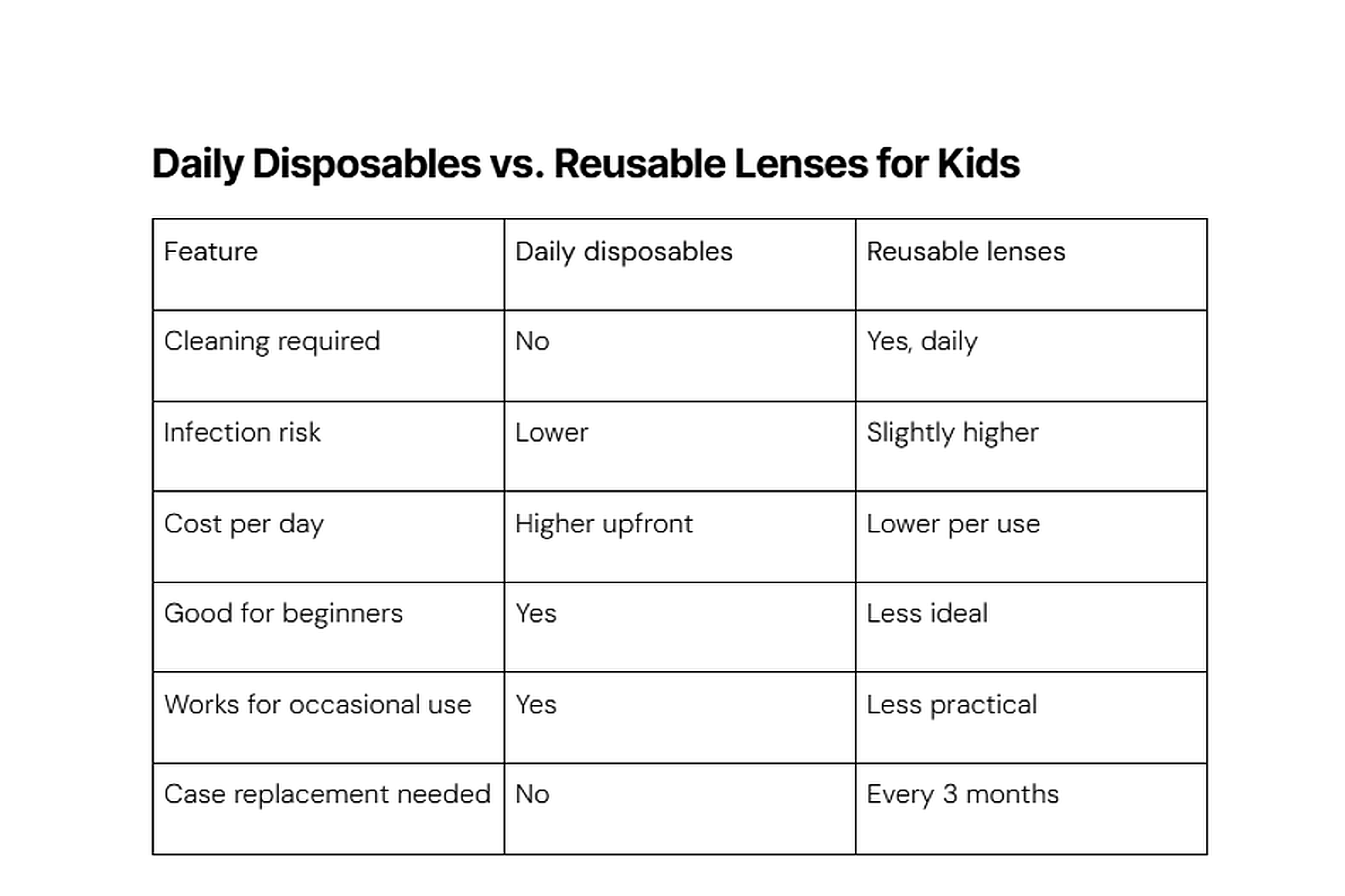
Children under 12 are most frequently prescribed daily disposables. Older children who demonstrate strong responsibility may move to biweekly or monthly lenses over time, but daily disposables remain the safest and simplest option while habits are still forming.
Myopia Control Lenses
If your child has progressing nearsightedness, ask your eye doctor about myopia control options. The FDA-approved MiSight 1 day lens from CooperVision is the first soft contact lens clinically proven to slow myopia progression in children aged 8 to 12, reducing progression by an average of 59 percent in a three-year clinical trial. Johnson and Johnson Vision's Acuvue Abiliti 1-Day is another daily disposable option, designed specifically for the smaller eyes of children and built for myopia management.
Standard single-vision contact lenses do not slow myopia progression. If your child's prescription is changing quickly each year, raise this with your eye doctor before choosing a lens type.
The Daily Hygiene Checklist Every Parent Should Teach
Most contact lens complications in children and teens come from skipped steps, not from the lenses themselves. A CDC report found that more than 85 percent of adolescents who wear contacts report at least one habit that raises infection risk. The most common are sleeping in lenses, skipping annual eye exams, and swimming while wearing contacts.
Knowing the rules is not enough. Research shows that 88 percent of wearers believe bacteria on fingers can transfer to the eye during lens insertion, yet 41 percent still skip handwashing before doing so. Dr. Edward Bennett, past chair of the AOA's Contact Lens and Cornea Section and professor at the University of Missouri-St. Louis College of Optometry, notes that dirty hands can directly result in a contaminated lens and lead to eye inflammation or infection. Teach these habits before the first day of wear and reinforce them consistently.
Before Putting Lenses In
- Wash hands thoroughly with soap and water for at least 20 seconds.
- Dry hands completely with a clean, lint-free cloth. Residual moisture can carry bacteria onto the lens.
- Check the lens is not inside out by placing it on a fingertip and checking the edge shape. A correctly oriented lens forms a smooth bowl. An inside-out lens has edges that flare outward.
- Insert lenses before applying any face products or eye makeup.
During the Day
- Wear lenses only during waking hours unless an eye doctor specifically prescribes extended wear.
- Never rub eyes while wearing lenses. Remove the lens first if the eye feels irritated.
- Keep backup glasses accessible at all times, including in the school bag and sports bag.
- Replace daily disposable lenses each day. Never reuse a daily lens.
Before Removing Lenses
- Wash and dry hands thoroughly before removal.
- Remove lenses before removing makeup.
- For daily disposables, discard used lenses. Do not save them for the next day.
- For reusable lenses, rub and rinse with fresh disinfecting solution. Never top off old solution with new. Store in a clean case.
Contact Lens Case Care (for Reusable Lens Wearers)
- Rub and rinse the contact lens case with fresh solution after each use.
- Let the case air dry upside down with caps off.
- Replace the case at least every three months. Germs accumulate in cases that are not replaced regularly.
Activity Rules: What Your Child Can and Cannot Do With Lenses In
Contact lenses offer real advantages for active kids. They provide full peripheral vision, do not fog up during exercise, and will not shatter during contact sports. Certain activities still require removing lenses first or adding protective eyewear.
Sports and Physical Activity
Contact lenses are generally a good choice for sports. They give children better peripheral vision than glasses and remove the risk of broken frames causing facial injury. Keep these rules in place:
- For contact sports such as hockey, soccer, or wrestling, wear protective sports goggles over contacts.
- The FDA recommends wearing safety goggles or glasses over lenses during all physical activities involving impact or fast-moving objects.
- Always keep a backup pair of glasses in the sports bag.
Swimming and Water Exposure
Water is the highest-risk environment for contact lens wearers. Tap water, pool water, lake water, and shower water all contain microorganisms that can contaminate lenses and cause serious infections. The most severe is Acanthamoeba keratitis, a rare but serious parasitic infection directly linked to water exposure while wearing contacts. The CDC notes that even household tap water, which is safe to drink, contains microorganisms that can infect the eye on contact with a lens.
The rules are clear:
- Remove lenses before swimming in any body of water, including pools, lakes, and oceans.
- Remove lenses before showering or getting in a hot tub.
- If lenses accidentally get wet, remove and discard them right away.
Daily disposables make this easier for swimmers. Your child removes the lens before getting in and starts fresh with a new pair afterward, with no storage or cleaning required.
Sleeping
The CDC reports that sleeping in contact lenses increases the chance of eye infection by 6 to 8 times. Unless an eye doctor specifically prescribes extended-wear lenses, your child should remove all lenses before sleeping. This includes short naps.
Warning Signs Every Parent Needs to Know
If your child reports any of the following symptoms, remove the lens right away. Do not wait to see if it improves.
Remove Lenses and Contact an Eye Care Provider if Your Child Reports:
- Redness that does not clear after the lens is removed
- Pain or burning that continues after removal
- Unusual light sensitivity
- Blurry vision that does not resolve once the lens is out
- A feeling that something is stuck in the eye after the lens has been removed
- Discharge or unusual moisture around the eye
Seek Same-Day Medical Attention if You Notice:
- Significant swelling of the eyelid
- Severe eye pain
- Vision loss or a shadow in the visual field
- A white or cloudy spot on the cornea, the clear front surface of the eye
The FDA notes that corneal ulcers are rare but can result in permanent vision loss if not treated quickly. Acting the same day matters.
Building a Routine That Actually Sticks
The biggest predictor of long-term success with contact lenses is not the lens type. It is whether the daily routine holds up on ordinary days, not just the first week.
Practical Ways to Reinforce Good Habits
- Post a printed checklist on the bathroom mirror covering insertion and removal steps.
- Set a phone reminder at the same lens removal time each night.
- Keep a backup glasses case in the school bag, sports bag, and bedroom.
- Schedule regular check-ins with your child's eye doctor during the first few months. Most providers recommend a follow-up visit at one week and again at one month after starting.
- Practice the removal routine together before the first independent day of wear.
The AOA recommends annual eye exams for all contact lens wearers. New pediatric wearers benefit from more frequent appointments while habits are developing. Your child's eye doctor will advise on the right schedule.
Getting Started With the Right Lenses
Once your child has a valid prescription from an eye care provider, ordering lenses is straightforward. Perfect Lens World carries the major daily disposable brands most commonly recommended for children, including Acuvue and CooperVision options, at some of the most affordable prices available in the US. Contact lenses are regulated by the FDA as medical devices and require a valid prescription, so make sure that is in hand before placing any order.
A Note for Parents
This article reflects current clinical guidance from the AOA, the American Academy of Ophthalmology (AAO), the American Academy of Pediatrics (AAP), and the CDC. It is intended to prepare you for the conversation with your child's eye care provider, not to replace it. Every child is different. Your eye doctor is the right person to confirm whether your child is ready and which lens fits their prescription and lifestyle.
If your child is asking about contacts and showing signs of readiness, the research supports taking that conversation seriously. With the right lens type, a consistent hygiene routine, and active parental support, most motivated children adapt quickly and wear their lenses without problems.

